

15 ChatGPT Prompts for Digital Marketing to Improve Content
Introduction
One of the biggest challenges digital marketers face is consistently creating engaging, valuable, and relevant content.
Whether you manage a business website, run social media campaigns, publish blog posts, or build a personal brand, coming up with fresh content ideas can be challenging. You need content that attracts the right audience, answers their questions, builds trust, and encourages them to take action.
This is where artificial intelligence (AI) tools like ChatGPT can help.
However, simply asking ChatGPT to “write a good blog post” or “create an Instagram caption” rarely produces the best possible results. The quality of AI-generated content depends heavily on the instructions, context, and information you provide.
This is why prompt engineering for digital marketing has become a useful skill for modern marketers, entrepreneurs, freelancers, and content creators.
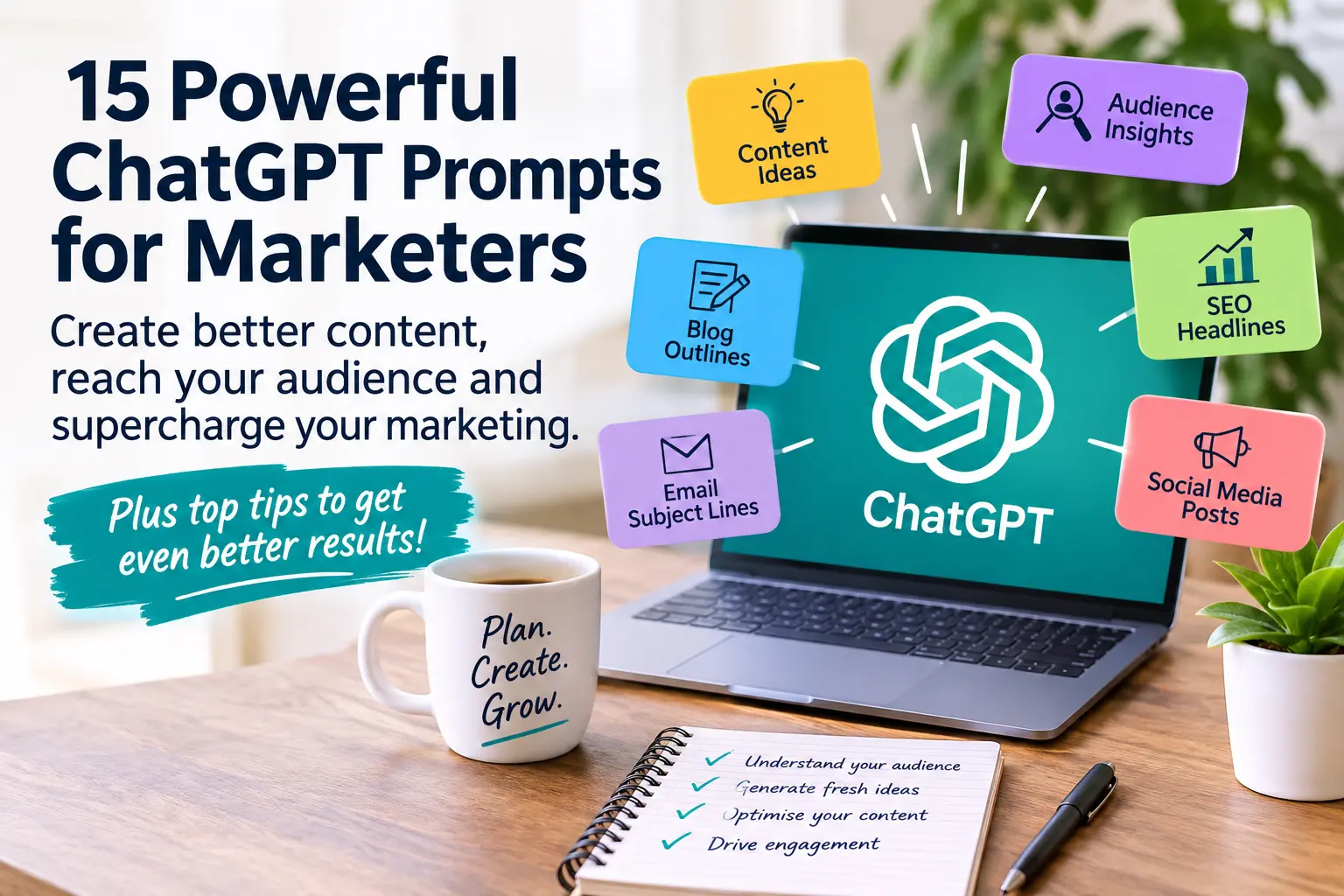
In this guide, you'll discover 15 practical ChatGPT prompts for digital marketing that you can customise for your business. These prompts will help you understand your audience, generate content ideas, write SEO-friendly blog posts, create social media content, repurpose existing material, and plan a consistent content marketing strategy.
Simply replace the text inside square brackets with your business-specific information and adapt the results to your needs.
Why Prompt Engineering Matters for Digital Marketers
Prompt engineering is the process of designing clear, structured instructions that help AI tools understand your objectives and generate more relevant outputs.
Well-written prompts can help you:
• Understand your target audience and their needs.
• Discover new content ideas and marketing opportunities.
• Develop SEO-friendly blog outlines and headlines.
• Create engaging social media posts and captions.
• Repurpose existing content for different platforms.
• Improve email marketing campaigns.
• Build a consistent content marketing strategy.
• Save time on repetitive content creation tasks.
The goal isn't simply to generate more content. It's to create content that serves a clear purpose and provides genuine value to your audience.
1. Strategic ChatGPT Prompts for Digital Marketing
Before creating content, you need to understand your audience, identify their problems, and communicate why your product or service is valuable.
The following five prompts help establish a strong foundation for your marketing strategy.
1. Create an Ideal Customer Profile
Understanding your audience is essential for an effective marketing strategy. Instead of creating generic content, you need to know what your ideal customers want, what challenges they face, and what influences their purchasing decisions.
Use this ChatGPT prompt:
Create a realistic audience profile for [product/service]. Identify the audience's key goals, frustrations, questions, concerns, and motivations. Explain how they would describe their problems in their own words. Separate reasonable assumptions from information that requires further research. Organise the findings into a clear, practical format.
How this prompt helps:
• Understand your ideal customers.
• Identify their major pain points.
• Develop content that addresses their problems.
• Create more relevant marketing messages.
Example: A digital marketing agency can use this prompt to understand why small business owners struggle to attract customers through online advertising.
The results can help the agency develop more relevant service pages, blog posts, advertisements, and lead-generation campaigns.
2. Discover the Questions Your Customers Ask
Potential customers usually have questions before purchasing a product or service. Answering those questions through useful content can help build trust and support purchasing decisions.
Use this ChatGPT prompt:
Generate 15 specific questions that potential customers may ask when considering [product/service]. Divide them into three categories: Awareness, Evaluation, and Decision. Keep the questions realistic, practical, and relevant to the target audience.
How this prompt helps:
• Discover potential blog topics.
• Understand customer search intent.
• Develop informative FAQ sections.
• Create content for different stages of the customer journey.
Example: An SEO agency might identify questions such as:
• Why isn't my website appearing on Google?
• How long does SEO take to produce results?
• Should I hire an SEO agency or manage SEO myself?
Each question can become a dedicated blog post, social media video, FAQ, or educational carousel.
3. Develop a Clear Value Proposition
Customers don't purchase products or services simply because they have features. They want solutions, benefits, and outcomes that matter to them.
A strong value proposition explains why your offering is useful and what makes it relevant to your target audience.
Use this ChatGPT prompt:
Explain what makes [product/service] valuable to [target audience]. Create five distinct value propositions based on these features: [list features]. Focus on customer benefits and practical outcomes rather than technical features alone. Keep each proposition clear, specific, and differentiated. Do not make claims that cannot be supported by evidence.
How this prompt helps:
• Communicate your business's value clearly.
• Create more persuasive advertisements.
• Differentiate your business from competitors.
• Focus on customer benefits rather than just features.
Example: Social Media Management
Instead of saying:
“We offer professional social media management.”
You could say:
“Build a consistent online presence while focusing on running your business.”
The second statement connects the service to a practical customer benefit.
4. Generate Fresh Content Marketing Ideas
Publishing the same type of content repeatedly can make your brand feel predictable. An effective content strategy should balance education, entertainment, engagement, and promotion.
Use this ChatGPT prompt:
Generate 12 creative content ideas about [topic] for [target audience]. Include practical tips, common myths, expert perspectives, frequently asked questions, mistakes to avoid, and emerging trends. Explain why each idea would be useful to the audience and recommend an appropriate content format, such as a blog post, short video, carousel, infographic, or email.
How this prompt helps:
• Overcome writer's block.
• Discover new content opportunities.
• Explore different audience interests.
• Build a varied content strategy.
Example: For a digital marketing business, possible topics include:
• Five Common Mistakes Small Businesses Make With Meta Ads
• SEO Myths Business Owners Should Stop Believing
• Organic Marketing vs. Paid Advertising
• Why Your Social Media Posts Aren't Generating Leads
Before publishing trend-based content, verify that the information is current and relevant.
5. Create a Marketing Message Map
Consistent messaging helps customers understand your offer across your website, advertisements, emails, and social media channels.
A message map brings your central message, supporting points, evidence, and responses to customer objections together in one place.
Use this ChatGPT prompt:
Create a detailed message map for a marketing campaign promoting [offer/initiative]. Include one central message, three supporting points, evidence or proof that can substantiate each point, potential customer objections, and a brief response to each objection. Use a [professional/friendly/persuasive] tone. Do not invent testimonials, statistics, customer experiences, or results. Clearly identify any evidence that still needs to be collected.
How this prompt helps:
• Maintain consistent brand messaging.
• Address customer objections.
• Improve advertising copy.
• Align website, email, and social media communications.
2. ChatGPT Prompts for Content Creation
Once your marketing strategy is clear, you can begin producing content that educates, informs, and engages your audience.
These five prompts focus on creating better blog posts, headlines, educational content, and social media posts.
6. Create a Detailed Blog Outline
A well-structured blog post answers the reader's main question in a logical order. Starting with an outline helps you organise your ideas before writing the full article.
Use this ChatGPT prompt:
Based on the notes below, create a detailed blog outline from the reader's perspective. Identify the main question the audience wants answered. Organise the sections logically, using clear H2 and H3 headings where appropriate. Explain what readers will learn in each section. Highlight claims, examples, and topics that require additional research. Avoid unnecessary sections and repetition.
Notes: [Insert your notes here].
How this prompt helps:
• Organise your ideas.
• Improve the article's structure.
• Make content easier to read.
• Keep the article focused on the reader's needs.
Pro tip: Review the outline before generating the full article. Add relevant first-hand experience, reliable sources, and any important points that AI may have missed.
7. Write an Engaging Blog Introduction
Your introduction helps readers decide whether the article is worth their time. It should establish relevance, introduce the topic, and explain what the reader can expect to learn.
Use this ChatGPT prompt:
Write three alternative introductions for a blog article about [topic]. Use these approaches: (1) a relatable problem, (2) a surprising but verifiable insight, and (3) a clear promise of what the reader will learn. Keep each introduction engaging, concise, realistic, and relevant to the target audience. Avoid exaggerated claims, fabricated statistics, unnecessary background information, and clickbait.
How this prompt helps:
• Create stronger blog openings.
• Experiment with different writing styles.
• Connect with readers more effectively.
• Improve the reading experience.
Choose the introduction that best matches your audience's needs and the article's actual content.
8. Generate SEO-Friendly Blog Headlines
A headline communicates what an article offers and helps readers decide whether to click. For search-focused content, it should accurately reflect the topic and use relevant keywords naturally.
Use this ChatGPT prompt:
Generate 15 headline options for an article about [topic]. Use the primary keyword [keyword] naturally where appropriate. Include a mix of direct, question-based, curiosity-driven, and how-to headlines. Keep every headline accurate, specific, readable, and relevant to the article. Avoid keyword stuffing, misleading promises, and clickbait. Recommend the three strongest options and explain why they may appeal to the intended audience.
How this prompt helps:
• Generate multiple headline options.
• Incorporate relevant keywords naturally.
• Create clear, reader-friendly headlines.
• Test different angles for search and social media.
Pro tip: Don't select a headline simply because it sounds exciting. Make sure the article delivers what the headline promises. Also validate your keyword and search intent using appropriate SEO research tools.
9. Simplify Complex Concepts
Technical subjects such as search engine optimisation, artificial intelligence, cloud computing, and financial technology can be difficult for beginners to understand.
Simplifying these topics can make your content more accessible without sacrificing accuracy.
Use this ChatGPT prompt:
Explain [complex concept] in simple language for [target audience]. Use practical examples and explain technical terms when they first appear. Preserve all important information from the source material. Do not introduce unsupported facts, change the original meaning, or oversimplify important details. Clearly identify anything that is unclear or requires additional context.
Source material: [Insert your content here].
How this prompt helps:
• Make technical information easier to understand.
• Create beginner-friendly educational blogs.
• Improve the accessibility of your content.
• Explain complicated ideas to non-specialist audiences.
10. Turn Blog Articles Into Social Media Posts
A detailed article can provide material for multiple social media posts. Repurposing it helps you reach audiences who prefer different content formats.
Use this ChatGPT prompt:
Create five engaging social media posts based on the article below. Tailor each post to [platform] and [target audience]. Use different approaches, including practical tips, interesting insights, common mistakes, questions, and actionable advice. Include a natural call to action where appropriate. Preserve the article's meaning and use only facts supported by the source. Do not invent additional statistics or claims.
Article: [Insert article here].
How this prompt helps:
• Promote existing blog content.
• Maintain a more consistent social media presence.
• Reach audiences across multiple platforms.
• Save time during content production.
Remember to adapt the length, tone, formatting, and call to action to each platform rather than publishing identical posts everywhere.
3. ChatGPT Prompts for Content Repurposing and Optimisation
Creating original content takes time, but you can often extend its value by adapting it for different platforms and improving existing material.
The following five prompts help you make better use of the content you already have.
11. Repurpose One Piece of Content Into a Complete Content Pack
A single blog post, webinar, or research report can become several useful marketing assets.
Use this ChatGPT prompt:
Transform the following [article/webinar/report] into a comprehensive content pack containing:
1. One short promotional email.
2. Three social media posts.
3. One Instagram or LinkedIn carousel outline.
4. Five questions designed to encourage audience discussion.
5. Three short-form video ideas.
Tailor each asset to its intended platform and audience while preserving the source material's meaning. Keep the messaging consistent, avoid unnecessary repetition, and do not invent facts or results.
Source material: [Insert your content here].
How this prompt helps:
• Extend the value of existing content.
• Reach audiences on different platforms.
• Maintain a consistent marketing presence.
• Reduce repetitive content creation work.
For example, a single guide about SEO can become a newsletter, several short videos, a carousel, and a set of discussion questions.
12. Generate Effective Email Subject Lines
Your email subject line is often the first part of your message that subscribers see. A relevant, honest subject line can encourage readers to open an email, while misleading wording can damage trust.
Use this ChatGPT prompt:
Generate 12 subject lines for an email about [topic/offer]. Include professional, friendly, informative, and curiosity-driven options. Keep them concise, honest, specific, and relevant to the recipient. Avoid false urgency, misleading promises, and deceptive wording. Briefly explain the appeal of each option and recommend the three most suitable subject lines for [target audience].
How this prompt helps:
• Generate relevant subject line options.
• Experiment with different messaging styles.
• Improve email campaign planning.
• Maintain trust with subscribers.
Where possible, test different subject lines with your audience and evaluate the results using your email platform's reporting tools.
13. Edit and Optimise Existing Content
Not every draft needs a complete rewrite. Improving sentence structure, removing unnecessary repetition, and correcting grammatical errors can make existing content more effective.
Use this ChatGPT prompt:
Edit the following draft to make it clear, concise, engaging, and easy to read. Improve sentence flow, correct grammar and spelling, remove irrelevant repetition, and maintain the original meaning and intended tone. Flag factual claims, statistics, and statements that need evidence or verification. Do not add unsupported information.
Draft: [Insert your content here].
How this prompt helps:
• Improve blog readability.
• Correct grammar and writing issues.
• Make content more professional.
• Identify claims that need verification.
Pro tip: Ask for an edited version and a short list of significant changes. This makes it easier to review what has changed before publishing.
14. Write Clear Calls to Action (CTAs)
A call to action (CTA) tells readers what they can do next. Depending on your marketing goal, you might want them to explore your services, book a consultation, download an ebook, or subscribe to a newsletter.
Use this ChatGPT prompt:
Create eight effective calls to action for [website page/campaign]. The goal is to encourage [target audience] to take the next step towards [goal]. Keep each CTA clear, action-oriented, and appropriate to the audience's level of interest. Use a [friendly/professional/persuasive] tone. Avoid unrealistic promises and unnecessary pressure. Where relevant, provide variations for buttons, banners, and social media posts.
How this prompt helps:
• Improve website messaging.
• Encourage meaningful customer actions.
• Create better advertisements.
• Align CTAs with specific marketing objectives.
Examples of effective CTAs:
• Explore Our Services
• Book Your Consultation
• Download Your Copy Today
• Let's Discuss Your Project
• Start Growing Your Business
Choose a CTA that accurately describes what happens after the reader clicks.
15. Create a Monthly Editorial Calendar
Consistency is important in content marketing, but publishing without a plan can lead to repetitive topics, missed opportunities, and inconsistent messaging.
A monthly editorial calendar helps you organise content around your audience's needs and business goals.
Use this ChatGPT prompt:
Create a monthly editorial calendar for [brand/business]. The primary marketing goal is [goal], and the target audience is [audience].
For each of the four or five publishing weeks in the month, suggest:
• One main piece of content.
• Two supporting pieces of content.
• The topic and recommended format for each item.
• The audience need or problem it addresses.
• The intended call to action.
• A suggested publishing day.
• The purpose of the content: education, promotion, entertainment, or engagement.
Maintain a balanced content mix. Identify topics that require current research or trend verification. Present the calendar in a clear table and explain how each week's content supports the overall marketing goal.
How this prompt helps:
• Build a consistent publishing schedule.
• Organise content creation in advance.
• Balance promotional and educational posts.
• Connect content topics with business objectives.
Example: A digital marketing agency might publish an SEO educational blog in the first week, a Meta Ads tutorial in the second, a client-approved case study in the third, and a service-focused post in the fourth.
Adapt the schedule to your team's capacity, audience activity, and business priorities.
5 Tips for Getting Better Results From ChatGPT
Using these 15 prompts is a useful starting point, but simply copying and pasting them will not guarantee excellent results.
The quality of your output also depends on the context, instructions, source material, and human judgement you bring to the process.
1. Provide More Context
Don't simply ask ChatGPT to write a blog post. Explain your business, industry, target audience, product or service, marketing objective, and the problem your content should solve.
The more relevant information you provide, the easier it is to generate content that fits your needs.
2. Define Your Brand's Tone of Voice
Every business communicates differently. Some brands sound professional and authoritative, while others use a friendly, conversational, humorous, or educational style.
Tell ChatGPT which tone you want. You can also share a short sample of your existing content so it can better match your preferred writing style.
3. Ask AI to Identify Missing Information
When important information is missing, AI may make assumptions that do not match your business or audience.
Ask it to separate confirmed information from assumptions and identify what needs clarification or further research before creating the final content.
4. Verify Facts Before Publishing
AI-generated content can contain inaccurate statistics, outdated information, or unsupported claims.
Always verify important facts, research findings, customer testimonials, case studies, and industry claims against reliable sources. Never publish invented testimonials or present unverified numbers as facts.
5. Add Your Own Expertise and Experience
AI should support your marketing efforts, not replace your judgement.
Enhance generated content with your own industry knowledge, genuine customer insights, practical examples, original analysis, and brand personality. This makes your content more useful and distinctive.
Conclusion: Use ChatGPT to Create Better Marketing Content
Prompt engineering is a valuable skill for digital marketers, business owners, freelancers, and content creators.
With the right instructions, tools like ChatGPT can help you understand your audience, generate content ideas, develop SEO-friendly articles, create social media posts, repurpose existing material, and plan a more consistent marketing strategy.
The 15 ChatGPT prompts in this guide provide a practical starting point for improving your content creation process.
However, remember that generating content is only one part of successful marketing. Research, originality, accuracy, audience understanding, and human judgement remain essential.
Your next step: Choose one prompt that matches your current marketing goal and apply it to your next project. Review the output, verify the facts, add your expertise, and refine the result before publishing.
Use AI to work more efficiently—and focus your creativity on creating content that genuinely helps your audience.
Frequently Asked Questions (FAQs)
1. What is prompt engineering in digital marketing?
Prompt engineering in digital marketing is the process of writing clear, structured instructions for AI tools such as ChatGPT. It helps marketers generate more relevant content ideas, audience insights, blog outlines, social media posts, and marketing materials.
2. How can marketers use ChatGPT?
Marketers can use ChatGPT to brainstorm blog topics, draft social media captions, develop email campaigns, create content calendars, identify customer questions, improve existing drafts, and repurpose content across platforms.
The output should be reviewed and adapted before publication.
3. What makes a good marketing prompt?
A good marketing prompt includes a clear objective, relevant business context, target audience, desired format, tone of voice, and specific instructions. It should also explain what the AI should avoid, such as unsupported claims, fabricated statistics, or unnecessary repetition.
4. Can ChatGPT help with SEO content?
Yes. ChatGPT can assist with blog outlines, headline ideas, FAQs, meta descriptions, topic clusters, and content optimisation. However, marketers should still conduct keyword research, validate search intent, review competing content, and verify important facts.
5. Is AI-generated content ready to publish?
Not necessarily. AI-generated content may require fact-checking, editing, original insights, source verification, and brand-specific improvements before publication.
Reviewing content carefully helps ensure that it is accurate, useful, and aligned with your audience's needs.
6. How many ChatGPT prompts should marketers use?
There is no fixed number. Start with the prompts that match your immediate goal.
For a blog article, for example, you might begin with audience profiling, content outlining, headline generation, and draft optimisation. Add other prompts when they support your workflow.
7. Can beginners use ChatGPT for content marketing?
Yes. Beginners can use structured prompts to brainstorm ideas, understand basic marketing concepts, draft content, and plan campaigns. Starting with a clear objective and reviewing every output carefully will help them develop their skills.
8. Can ChatGPT replace a digital marketer?
ChatGPT can assist with many repetitive and research-intensive tasks, but effective marketing also requires strategic thinking, customer understanding, creativity, communication, and business judgement. It is best used as a tool that supports marketers rather than as a complete replacement for human expertise.
Final takeaway: Better prompts can lead to more useful AI-generated content, but the strongest marketing results come from combining AI efficiency with human creativity, research, and experience.