

Java4Shell (CVE-2026-114938): Affected Versions and Fix

Java4Shell (CVE-2026-114938): What It Is, Who Is Affected and How to Fix It
Java4Shell (CVE-2026-114938) is a critical memory-corruption bug inside the Java runtime itself. If your servers run OpenJDK 17.0.6 or later, 21, 25 or 27 on an Intel or AMD processor with AVX-512 VBMI, a short malformed Base64 string can overwrite memory in the JVM. In the right conditions that leads to remote code execution with no login. The fix is to upgrade to 17.0.21.1, 21.0.13.1, 25.0.5.1 or 27.0.1.1 (or your vendor's equivalent) and restart every JVM. If you cannot patch today, start Java with this flag:
-XX:-UseBASE64IntrinsicsThe name is a deliberate nod to Log4Shell from 2021. But this bug is not in a library you added to your project. It lives in HotSpot, the engine that runs Java programs, so updating your pom.xml will not fix it.
This guide covers what the bug is, why it happens, which Java versions and CPUs are affected, how to check your own servers in four steps, and exactly how to fix it. It is written for developers, sysadmins and business owners who run Java apps such as Jira, Jenkins, Keycloak or Elasticsearch.
Java4Shell at a Glance: Key Facts
Item | Detail |
|---|---|
Name | Java4Shell |
CVE ID | CVE-2026-114938 |
Bug type | Heap out-of-bounds write (memory corruption) |
Where | HotSpot JVM's AVX-512 Base64 decoder intrinsic on x86-64, used by C2-compiled code |
Severity | CVSS 3.1: 8.1 High (Oracle). CVSS 4.0: 9.2 Critical (Calif, the researchers). Red Hat rates it Critical. |
CVSS 3.1 vector (Oracle) |
|
Affected Java | OpenJDK 17.0.6 and later 17 builds, 21, 25, 27, end-of-life non-LTS releases 18 to 20 and 22 to 24 and 26, and Oracle Java SE 8 Enterprise Performance Pack 8u511b33-perf |
Not affected | Standard Java 8 and 11 builds, ARM64 servers, and x86 CPUs without AVX-512 VBMI |
Fixed builds | 17.0.21.1, 21.0.13.1, 25.0.5.1, 27.0.1.1 (Oracle Java SE 8 Performance Pack: 8u513-perf) |
Credited to | Quang Luong of Calif.io (credited by Oracle) |
Disclosed | 17 November 2026, with Oracle's November 2026 Critical Security Patch Update |
Exploited in the wild? | Probes and attempts seen. No confirmed successful compromise reported as of 26 November 2026. |
Quick workaround |
|
What Is Java4Shell?
Java4Shell, tracked as CVE-2026-114938 by Oracle and OpenJDK, is a flaw in the fast, hand-written machine code that the Java runtime uses to decode Base64 on modern Intel and AMD server CPUs. When it receives a specially malformed Base64 string, it writes past the end of a memory buffer. That corrupts whatever object sits next to it in memory.
To understand why that matters, you need three building blocks: Base64, intrinsics and AVX-512.
What is Base64?
Base64 turns raw binary data into plain text. Every 3 bytes of input become 4 text characters. When the input is not a multiple of 3 bytes, the standard form ends with one or two = padding characters, so correctly padded Base64 always has a length that is a multiple of 4.
Java's built-in java.util.Base64 class has three decoders:
Basic (
Base64.getDecoder()): uses A to Z, a to z, 0 to 9,+and/. Used for HTTP Basic authentication headers, SAML assertions and many API fields. Uses the vulnerable fast path.URL-safe (
Base64.getUrlDecoder()): swaps+and/for-and_. Used for JWT tokens (RFC 7519), which usually drop the=padding. Uses the vulnerable fast path.MIME (
Base64.getMimeDecoder()): handles line-wrapped Base64 (RFC 2045), such as email attachments and PEM certificate files. Published analyses say it does not use the vulnerable AVX-512 path.
Third-party Base64 libraries do not use this code either. So any Java service that decodes user-supplied Base64 with the basic or URL-safe decoder is a candidate.
What is an intrinsic?
Java code normally runs as bytecode, which the JVM's Just-In-Time (JIT) compiler turns into machine code. For a few very busy methods, HotSpot swaps in a hand-written assembly routine called an intrinsic. Base64 decoding is one of them.
Here is the catch. Java is memory-safe, but an intrinsic is raw assembly. It does not get Java's automatic bounds checks, so a mistake in it can write outside an array, just like a bug in C.
What is AVX-512 VBMI?
AVX-512 is a set of Intel and AMD CPU instructions that process 64 bytes at once. VBMI (Vector Byte Manipulation Instructions) is an extension of it. In 2021, OpenJDK added an AVX-512 Base64 decoder, tracked as JDK-8268276. It first shipped in JDK 18 (March 2022). It was then backported to OpenJDK 17.0.6 (January 2023) under backport issue JDK-8296735.
That is why 17.0.6 is the starting line for the Java 17 LTS line, and JDK 18 is the starting line for mainline releases. Standard Java 8 and 11 builds never received this decoder, so they are not affected. The one exception is Oracle's Java SE 8 Enterprise Performance Pack (build 8u511b33-perf), which is vulnerable and fixed in 8u513-perf.
Why Is It Called "Java4Shell"?
The researchers at Calif chose the name to echo Log4Shell (CVE-2021-44228), the 2021 Log4j flaw that hit almost every Java shop. The comparison is about reach, not how the attack works.
Log4Shell (2021) | Java4Shell (2026) | |
|---|---|---|
Where the bug is | Log4j library, added by developers | The JVM itself (HotSpot) |
Fix | Update a dependency | Update the JDK or JRE and restart |
How hard to exploit | Trivial, one string worked almost everywhere | Hard, needs a custom chain for each app |
Hardware condition | None | x86-64 CPU with AVX-512 VBMI |
Dependency scanners | Found it | Can miss it, because it is in the runtime |
Root Cause: How One = Sign Breaks Memory
In short, the decoder subtracts the = padding from a leftover chunk that holds no full Base64 group. The result goes negative, and the CPU then writes a full 64 bytes instead of zero.
Step by step
Java sizes the output buffer correctly. For padded input it uses: output length = ceil(input length ÷ 4) × 3 − padding. (For unpadded input whose length is not a multiple of 4, it uses 3 × floor(length ÷ 4) + (length mod 4) − 1. So a 65-character unpadded string gets a 48-byte buffer.)
The trigger input is tiny. 64
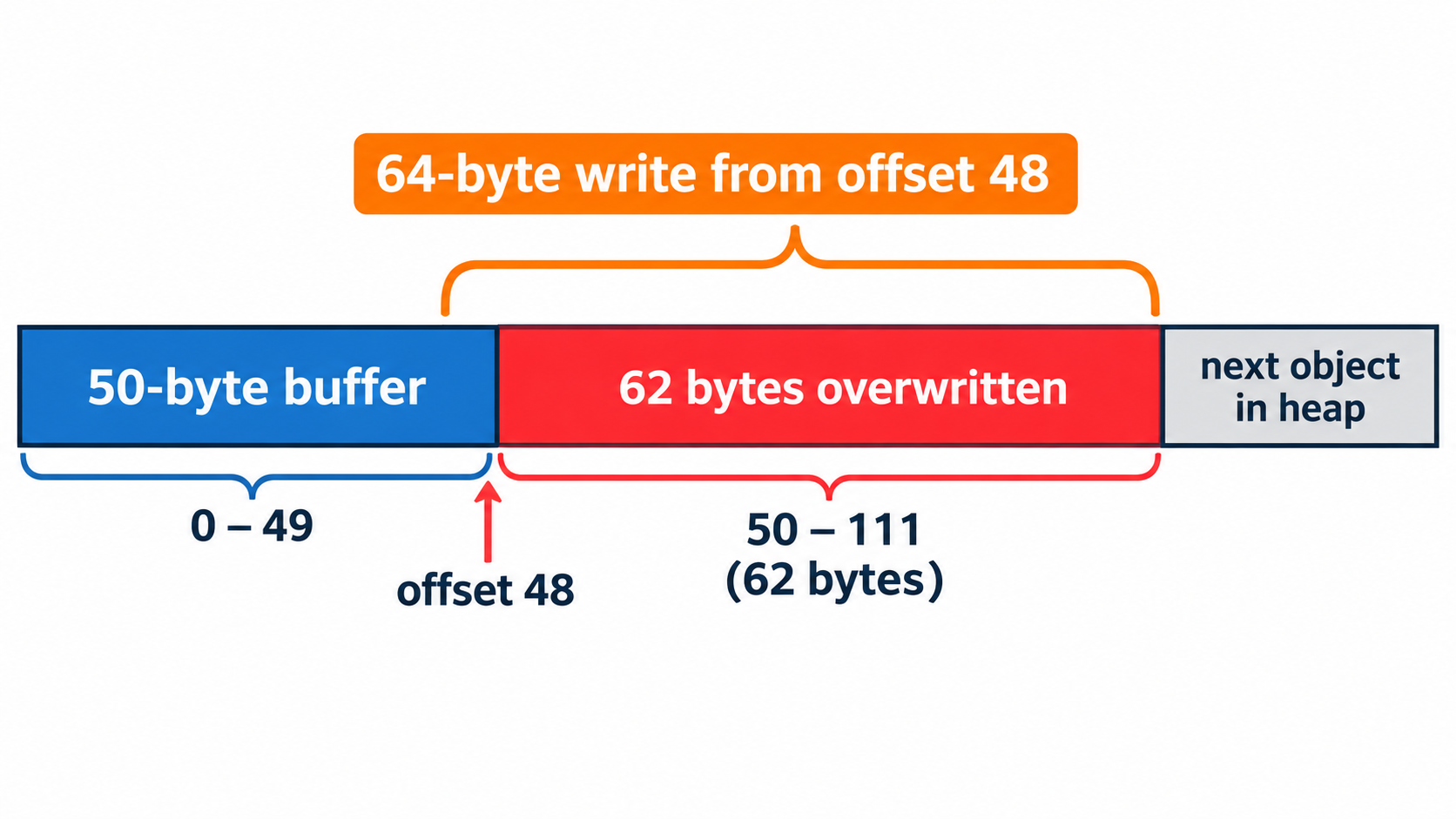
Acharacters followed by one=is 65 characters. The formula gives ceil(65 ÷ 4) × 3 − 1 = 17 × 3 − 1 = 50 bytes.The fast vector path decodes the first 64 characters into 48 bytes (offsets 0 to 47).
The leftover tail is just
=. For the tail, the intrinsic first computes floor(tail length ÷ 4) × 3, which is 0 for a tail of 1 to 3 characters. Then, because the input ends in padding, it subtracts 1 for each=(up to 2). It never checks that the tail holds at least one full 4-character group. So the output length becomes 0 − 1 = −1, or 0 − 2 = −2. Calif lists tails such as=,==,X=,X==,XY=and===as producing this underflow.The write mask goes wrong. The code builds a byte mask with the BMI2 instruction
BZHI, starting from all ones. BZHI reads the low 8 bits of the length as an unsigned bit position. In two's complement, −1 is 255 and −2 is 254. BZHI only clears bits when that position is below 64, so here it clears nothing and the mask stays all ones.The masked store writes everything. The
VMOVDQU8(evmovdqub) store, which should write 0 bytes, writes 64 bytes starting at offset 48. In a 50-byte array, that puts 62 bytes past the end (63 bytes with==, where the buffer is 49 bytes), on top of whatever object sits next in the heap.Java then rejects the input. It throws
IllegalArgumentExceptionfor invalid Base64, but the damage is already done.
That last step is what makes this bug so sneaky. Catching the exception or validating the decoded result does not save you, because the memory is corrupted inside the decoder before the error is raised.
Trigger conditions
Input length. On Java 21, 25 and 27, the smallest trigger is 64
Acharacters plus=(65 characters). Calif says older OpenJDK 17 builds need 128Acharacters plus=(129 characters), because the length needed to reach the vector code is higher there. Calif does not name the exact 17.0.x boundary. So for defence, treat any padded Base64 string of 65 characters or more as a possible trigger on every affected Java 17 build. A 129-character payload works on both.JIT compilation. The intrinsic only runs once the decoder has been compiled by C2. Any busy service that decodes Base64 regularly gets there on its own.
Decoder type. The basic and URL-safe decoders are affected. The MIME decoder is not.
Hardware conditions
The buggy code only runs on x86-64 CPUs that report all four of these flags: avx512f, avx512bw, avx512vbmi and bmi2. In practice that means:
Intel Xeon: Ice Lake, Sapphire Rapids, Emerald Rapids, Granite Rapids and newer.
AMD EPYC and Ryzen: Zen 4 and newer.
Not affected: ARM64 servers (AWS Graviton, Ampere, Apple silicon), other non-x86 platforms such as s390x and ppc64le, and older x86 CPUs without AVX-512 VBMI.
Many cloud virtual machines run on exactly these Intel and AMD chips, which is why exposure is wide.
From a Memory Bug to Remote Code Execution
On its own, the bug gives an attacker a weak tool. They control where the overflow lands, but not most of the bytes written. Calif showed how to grow that into full code execution, but each target application needs its own custom chain. There is no one-click exploit that works everywhere.
At a high level, Calif's research describes these stages:
Warm up the decoder so the vulnerable intrinsic is active.
Arrange the heap so a useful object sits right after the decode buffer. Calif did this with carefully timed network requests.
Overflow into a neighbour, corrupting the length field of a nearby array.
Turn that into a stronger write using the enlarged array.
Leak memory. Calif calls this step JavaBleed. It can expose secrets in the Java process even if code execution never happens.
Take over the Java process once the attacker can read and write heap memory.
What an attacker can get
A crash (denial of service): the easiest outcome. A corrupted heap can kill the JVM.
A data leak: heap memory can hold personal data, private keys, session tokens and passwords.
Remote code execution: full control of the Java process, with no login on some apps.
Why it is harder to exploit than Log4Shell
Each target needs its own delivery path and chain.
Heap grooming depends on timing, so network latency matters.
Reverse-proxy request buffering, such as nginx's default, breaks some timing-based variants. It is not a full defence. Some single-request paths and WebSocket traffic are not affected by buffering.
Calif published only a safe proof of concept and is holding back product-specific exploits.
Independent labs have so far reproduced crashes and memory leaks but, as of 18 November, had not publicly reproduced code execution. VulnCheck said it had a working exploit available to its customers.
Applications Calif says it exploited
Access needed | Applications |
|---|---|
None (pre-auth RCE) | Keycloak, Atlassian Jira, Atlassian Confluence, JFrog Artifactory, Jenkins, PingFederate |
Logged-in user (post-auth RCE) | Apache Kafka Broker, Apache Solr, Elasticsearch (plus an unauthenticated crash is possible, per Elastic), Gerrit, Spinnaker |
Other exposure | Sample apps on Struts and Spring Boot; Java clients that connect to a malicious TLS server (client-side attack) |
This list is not complete. Web services, APIs, single sign-on servers and message consumers that decode untrusted Base64 are the highest-risk group.
Java4Shell Affected Versions and Fixed Versions
The simple rule: a fixed upstream build has a fourth version number of 1, for example 21.0.13.1. Count the dots: in 27.0.1.1 the fourth number is 1 (fixed), but 27.0.1 has no fourth number, and it is the vulnerable October release. The October builds 17.0.21, 21.0.13, 25.0.5 and 27.0.1 are all still vulnerable.
Oracle and OpenJDK CVE-2026-114938 fixed versions
Java line | Vulnerable | Fixed in |
|---|---|---|
Java 27 | Up to 27.0.1 (Oracle: 27.0.1.0.3) | 27.0.1.1 |
Java 25 | Up to 25.0.5 (Oracle: 25.0.5.0.3) | 25.0.5.1 |
Java 21 | Up to 21.0.13 (Oracle: 21.0.13.0.3) | 21.0.13.1 |
Java 17 | 17.0.6 to 17.0.21 (Oracle: 17.0.21.0.3) | 17.0.21.1 |
Oracle Java SE 8 Enterprise Performance Pack | 8u511b33-perf | 8u513-perf |
Java 18, 19, 20, 22, 23, 24, 26 (non-LTS, end of life) | Contain the vulnerable decoder (it is in mainline from JDK 18) | Generally no fix. Amazon lists "no fix planned" for 22, 23, 24 and 26. Move to 21.0.13.1, 25.0.5.1 or 27.0.1.1. |
Standard Java 8 and 11 | Not affected | Nothing to patch for this bug |
Oracle lists only the builds it supports and says earlier versions are likely also affected.
Linux distributions and JDK vendors
Vendors moved at different speeds. This table reflects vendor pages and reports from 17 to 26 November 2026. Always check your vendor's own advisory for the latest.
Vendor | Status |
|---|---|
Oracle Java SE | Fixed on 17 November in the November 2026 Critical Security Patch Update |
Amazon Corretto / Amazon Linux | Fixed: 17.0.21.1.2, 21.0.13.1.2, 25.0.5.1.2, 27.0.1.1.4. Corretto 8 and 11 not affected. Amazon scores it 8.8. |
Eclipse Temurin | Fixed builds for 21 (21.0.13.1+2), 25 (25.0.5.1+2) and 27 (27.0.1.1+4) by 18 November. The Java 17 fix came later, so check Adoptium. |
Red Hat (RHEL 8, 9, 10) | Rated Critical (preliminary score 9.8). Fixes being expedited; apply errata as they appear. |
Debian | Fixed in security updates: openjdk-17 17.0.21.1+2-1~deb12u1 (bookworm), openjdk-21 21.0.13.1+2-1~deb13u1 and openjdk-25 25.0.5.1+2-1~deb13u1 (trixie). Testing (forky) was still vulnerable when checked. |
Ubuntu | Fixes for openjdk-17, 21, 25 and 27 packages reported on 18 November |
Microsoft Build of OpenJDK | Fixed builds available (reported 19 November) |
Azul Zulu, BellSoft Liberica, SAP SapMachine, others | Check the vendor's advisory. Vendor build numbers are not interchangeable. |
Watch out: version strings can fool you
Always look at the fourth number. In Amazon's fixed
17.0.21.1.2, the fourth number is 1 (fixed). In Debian testing's21.0.13.0.3, the fourth number is 0 (vulnerable), even though the string is long.Do not judge by length or by the last digit. Some vendors add a fifth number or a build suffix such as
+2. Only the fourth number tells you about this fix.Vendor build numbers are not interchangeable. A Corretto version number means nothing for Temurin. When in doubt, match your exact string against your vendor's advisory.
Products that ship their own Java
Many products bundle their own Java runtime. Patching the system JDK does not fix them.
Atlassian: Cloud products are already remediated, and no customer action is needed. For Data Center (Jira, Jira Service Management, Confluence, Bitbucket, Bamboo, Crowd), Atlassian's official mitigation is the wider AVX flag (Option B below), not the Base64-only flag. Atlassian adds a second flag so the same setting also works on ARM servers:
-XX:UseAVX=2 -XX:+IgnoreUnrecognizedVMOptionsAs of 25 November, fixed versions include Jira 10.3.28 and 11.3.14, Confluence 9.2.30 and 10.2.22, Bamboo 10.2.27, 12.1.14 and 13.0.2, and Bitbucket 9.2.28, 10.2.10 and 10.5.3. Atlassian plans a full advisory on 1 December 2026.
Jenkins: Jenkins says controllers are at risk on Java 17 (17.0.6 to before 17.0.21.1), Java 21 (before 21.0.13.1) and Java 25 (before 25.0.5.1), only on x86-64 CPUs with AVX-512 VBMI. Those are the Java lines Jenkins supports. If you run Jenkins on any other affected JDK, such as 27, the same rule applies. Upgrade Java and restart. Until then, Jenkins suggests adding the Base64 flag (Option A below) to
JAVA_OPTS.Keycloak: x86-64 container images tagged 26.8.2-1 and 26.8.2-2 bundled an affected Java build. Images tagged 26.8.2-3 (and latest, 26.8, 26.8.2) use the fixed Red Hat OpenJDK 21.0.13.1.
Siemens and Tenable have also published notices for some of their products, including Siemens Industrial Edge Management. Check each vendor's advisory.
Containers: any image built on a vulnerable Java base stays vulnerable until you rebuild it. Re-pull base images even if the tag name did not change.
Elasticsearch CVE-2026-114938
Elastic says Elasticsearch 7.17.3 and later are vulnerable on affected CPUs. Code execution needs a user with at least "read" access, but unauthenticated attackers can crash nodes (denial of service). Logstash 8.6.2 and later can crash only in a specific setup: the elastic_integration filter with an ingest pipeline that decodes Base64 from an untrusted source. Elastic Cloud has already been hotfixed or mitigated, and Elastic reports no sign of exploitation. Elastic plans to ship a bundled JDK of 27.0.1.1 in upcoming releases. Until then, its interim fix is the Base64 flag (Option A below), set through jvm.options.d.
Cisco CVE-2026-114938
Cisco published advisory cisco-sa-nov2026-java-rce-eCa6ss9z on 18 November 2026 and rates it High. As of version 1.4 (23 November, still marked Interim):
Affected: 26 products are listed, including Secure Network Analytics, Secure Workload, Finesse, Unified Contact Center Enterprise, Unified Intelligence Center, HyperFlex HX Data Platform, Intersight Virtual Appliance, Smart Software Manager On-Prem and Splunk AppDynamics On-Prem.
Not affected: IOS XE, IOS XR, NX-OS, Identity Services Engine (ISE), Secure Firewall ASA, FMC and FTD, Catalyst SD-WAN, Nexus Dashboard and Catalyst Center (Catalyst Center was moved to "not affected" in a later revision).
Fixes: most fixed releases were still "TBD". Cisco says there are no workarounds for its products.
Exploitation: Cisco knows of public proof-of-concept code but is not aware of malicious use.
Cisco is still investigating its product line, so check the advisory for updates.
Palo Alto Networks CVE-2026-114938
Palo Alto Networks published a portfolio status bulletin on 19 November 2026 (refreshed 20 November). It scores the flaw CVSS 4.0 9.2 (Critical) with "Moderate" suggested urgency.
Not affected: PAN-OS based products, including NGFW (PA-Series, VM-Series and AIRS), Panorama, WF-500-B and the PAN-DB private cloud appliance. So Palo Alto firewalls themselves are not affected.
Affected (Idira products only): Privilege Threat Analytics (fixed in 15.2.3 and 14.6.4; all 15.0 versions should move to 15.2.3 or later), Remote Access Connector (fixed in 1.1.1002202), Remote Access Connector CLI (fixed in 1.1.3701) and Secure Access with an HTML5 Gateway on-prem (fixed in 15.0.3.21 and 15.2.2.17).
SaaS products: Palo Alto is rolling out fixes itself, so no customer action is needed.
Exploitation: Palo Alto is not aware of any malicious exploitation. It says no workarounds exist for the affected Idira products.
Palo Alto is still reviewing its portfolio. Java apps you run yourself on Palo Alto infrastructure remain your responsibility to patch.
Severity: Why Different Scores?
You will see 8.1, 8.8, 9.2 and 9.8 quoted. They come from different scoring systems and different organisations.
CVSS 3.1 = 8.1 (High), from Oracle. Vector:
CVSS:3.1/AV:N/AC:H/PR:N/UI:N/S:U/C:H/I:H/A:H.CVSS 3.1 = 8.8, from Amazon. Amazon rates attack complexity low but requires low privileges.
CVSS 4.0 = 9.2 (Critical), from Calif, the researchers.
9.8 (preliminary), from Red Hat, which rates the issue Critical.
In plain English, Oracle's vector says: attackable over the network, high attack complexity (heap grooming and timing make it hard), no privileges needed, no user interaction, and high impact on confidentiality, integrity and availability. The "high complexity" part is what keeps Oracle's score below 9.
Is Java4Shell Being Exploited?
Attackers are clearly probing, but no confirmed successful compromise had been publicly reported as of 26 November 2026.
GreyNoise had logged 261 Java4Shell-shaped requests from 7 IP addresses since 17 November, with 0 successful intrusions on its sensors (page updated 26 November).
Previdian recorded 11 attempts from 8 attacker IPs in 6 countries between 18 and 24 November.
CISA published an alert on 17 November urging immediate patching, with input from the Canadian Centre for Cyber Security. Authorities in South Korea, Germany and the UK also urged companies to patch.
CISA KEV: not listed as of 24 November, so there is no US federal patch deadline yet. Check the KEV catalogue for updates.
Treat it as a matter of when, not if. AI tools now help attackers study a patch and write exploits quickly, so the gap between a fix and an attack keeps shrinking.
How Java4Shell Was Found
Calif researcher Quang Luong pointed OpenAI's Codex at OpenJDK internals and asked it to audit the JIT compiler, intrinsics and cryptography code. Most early findings were noise. Luong spotted this bug in about an hour and had a first working exploit about two hours later, for under $200 in AI costs. Calif calls this a "centaur" approach: AI does the wide search, a human expert judges the results and builds the exploit.
Calif's find was independent, but it was not the first sign of trouble. A crash in the same decoder was reported publicly in an Adoptium issue in June 2026. In September 2026, a developer (GitHub user albertnetymk) identified the root cause and proposed a fix (openjdk/jdk pull request #32781), which was closed unmerged in early November. Oracle's advisory credits Quang Luong of Calif.io.
Timeline
Date | Event |
|---|---|
2021 | AVX-512 Base64 decoder (JDK-8268276) added to mainline OpenJDK |
March 2022 | First released in JDK 18 |
January 2023 | Backported to OpenJDK 17.0.6 (JDK-8296735) |
June 2026 | A decoder crash is reported in a public Adoptium issue |
9 September 2026 | Proposed fix (openjdk/jdk #32781) describes the overflow; later closed unmerged |
12 November 2026 | Fix committed to the public jdk17u repository, five days before the advisory |
17 November 2026, 21:00 UTC | Oracle's November 2026 Critical Security Patch Update (655 new security patches in total, 11 of them for Java SE) and fixed OpenJDK builds released. Details had leaked earlier that day. |
17 November 2026, 21:13 UTC | Calif publishes "Java4Shell: Write once, RCE everywhere". CISA issues its alert the same day. |
18 to 19 November 2026 | Probing begins; Jenkins, Keycloak, Elastic and Linux distributions publish guidance and fixes |
25 November 2026 | Atlassian lists fixed Data Center versions |
26 November 2026 | Still no confirmed successful exploitation reported |
Am I Affected? A 4-Question Check
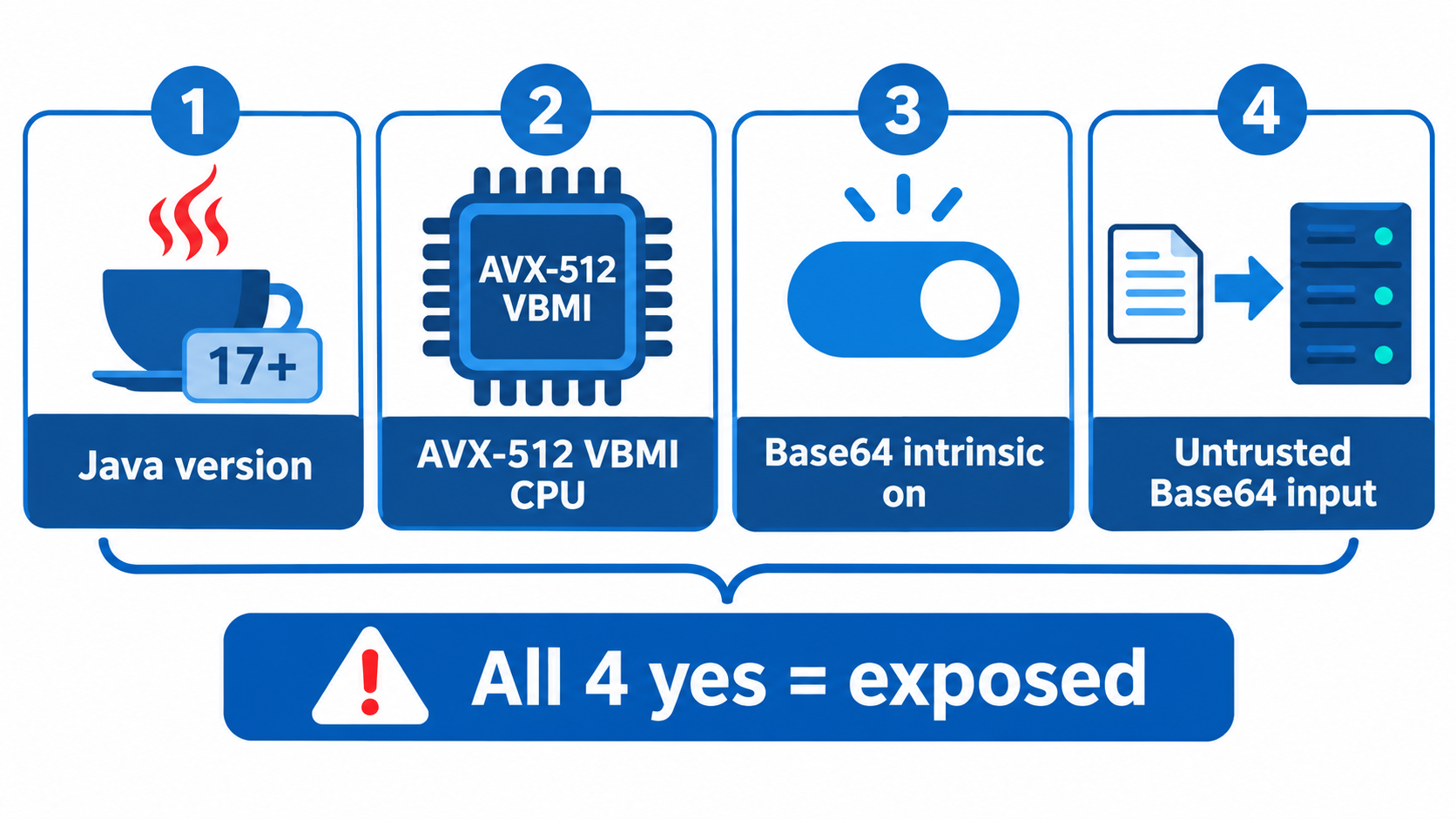
A host is exposed only if all four answers are yes.
1. Is the Java runtime an affected, unpatched version?
Run this for every runtime, including ones bundled inside apps and containers. The version banner prints to stderr, so the 2>&1 part makes it work in scripts too:
java -version 2>&1The answer is yes if it is any of these:
17.0.6 or later, 21, 25 or 27, where the fourth version number is not yet 1 (for example 21.0.13 or 21.0.13.0.3)
Oracle Java SE 8 Enterprise Performance Pack 8u511b33-perf
Any end-of-life non-LTS release: 18, 19, 20, 22, 23, 24 or 26
Check your vendor's version table too, since vendors number builds differently.
2. Does the CPU have AVX-512 VBMI?
On Linux, this prints all four flags if you are at risk:
grep -o -w -E 'avx512f|avx512bw|avx512vbmi|bmi2' /proc/cpuinfo | sort -uOn Windows or macOS (where /proc/cpuinfo does not exist), ask the JVM itself. It logs the CPU features it detected at startup:
java -Xlog:os+cpu -version3. Is the Base64 intrinsic using AVX-512?
java -XX:+PrintFlagsFinal -version | grep -E 'UseBASE64Intrinsics|UseAVX'You are exposed through this path only if the output shows UseBASE64Intrinsics = true and UseAVX = 3. If UseAVX is 0, 1 or 2, the AVX-512 code is not used.
This command tests a new JVM in your shell. For a service that is already running, check the live process instead (see "Verify every live process" below).
4. Can untrusted data reach the basic or URL-safe decoder?
Think of inbound data such as Basic auth headers, JWTs, SAML, uploads and API fields. Also think outbound: Java clients that connect to untrusted servers, including over TLS, can be attacked too. So backend workers and CI agents that accept no inbound traffic are not automatically safe.
If any answer is no, that host is not exploitable through this bug. Patch it anyway.
How to Fix Java4Shell (CVE-2026-114938 Patch and Workarounds)
1. Patch (the real fix)
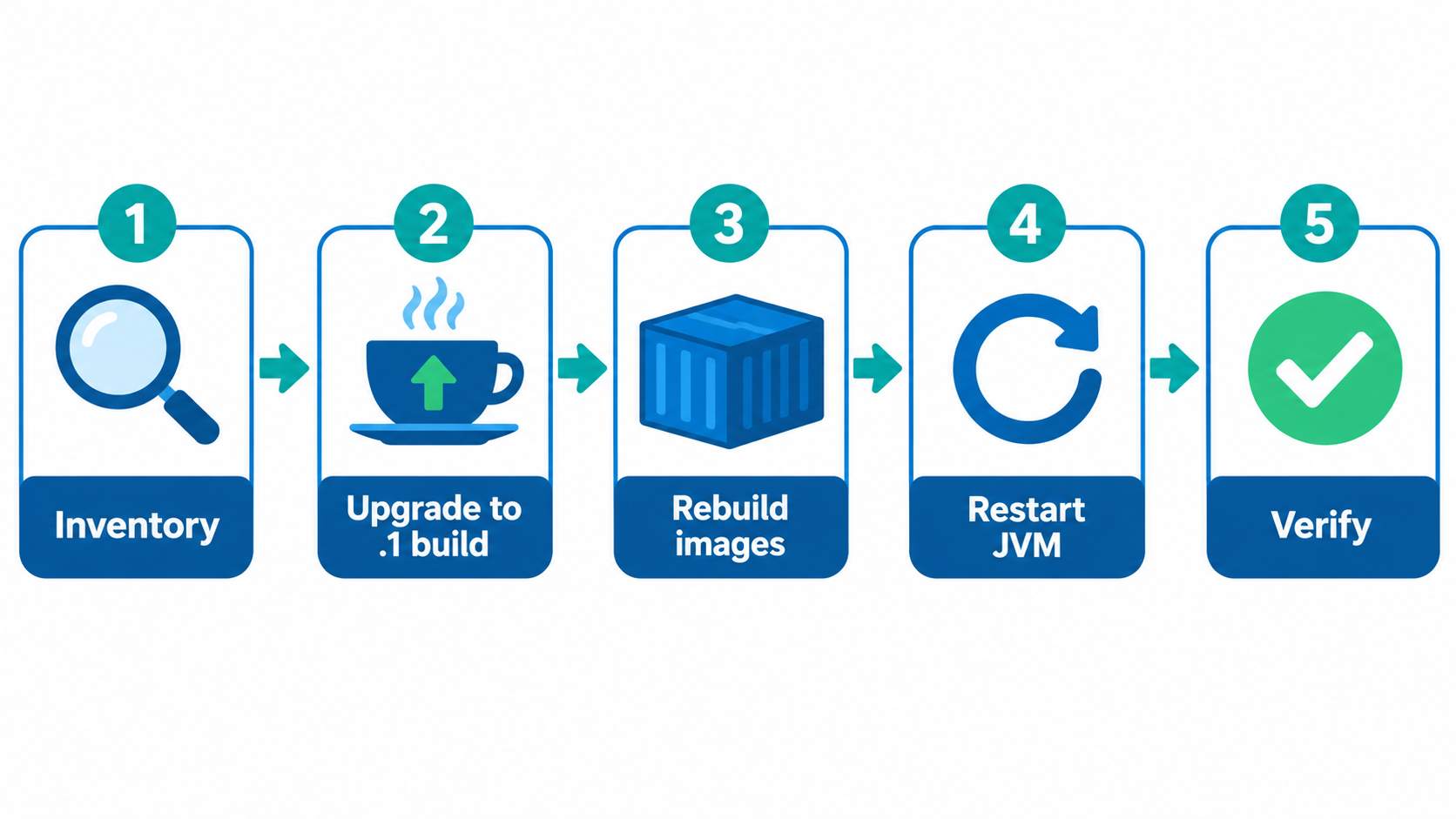
Inventory every Java runtime: servers, containers, CI agents, appliances and Java bundled inside third-party apps.
Upgrade to a fixed build: 17.0.21.1, 21.0.13.1, 25.0.5.1, 27.0.1.1, 8u513-perf, or your vendor's equivalent. If you are on an end-of-life release, move to a supported line.
Rebuild and redeploy container images. Re-pull base images even if the tag did not change.
Restart every JVM. A patched JDK on disk does nothing for a process still running the old one.
Apply vendor patches for products that ship their own Java (Atlassian, Elastic, Keycloak, Cisco, Siemens and others).
Start with internet-facing services: SSO and identity servers, Jira and Confluence, Jenkins and API gateways.
2. Temporary workarounds (until you can patch)
Start the JVM with one of these flags.
Option A (most targeted):
-XX:-UseBASE64IntrinsicsThis turns off the hand-written Base64 code, so Java uses its normal, bounds-checked code. Base64 gets slightly slower and nothing else changes. Red Hat, Jenkins, Elastic and Keycloak recommend it.
Option B (wider):
-XX:UseAVX=2This turns off AVX-512 for the whole JVM, which costs more performance in vector-heavy code. It is x86-64 only: on ARM64 the JVM refuses to start with it unless you also add the IgnoreUnrecognizedVMOptions flag, as Atlassian does. This is the option Atlassian chose for its Data Center products, so follow the vendor's advice for bundled apps.
Setting the flag with JAVA_TOOL_OPTIONS
For JVMs whose start command you cannot easily edit, you can use an environment variable:
JAVA_TOOL_OPTIONS=-XX:-UseBASE64IntrinsicsTwo cautions:
If your deployment already sets
JAVA_TOOL_OPTIONS, setting it again replaces the old value. Append the flag to the existing value instead.Options passed directly on the
javacommand line overrideJAVA_TOOL_OPTIONS. If the service's own start script sets the flag differently, the command line wins.
Verify every live process
Testing in your shell only proves your shell has the setting. A systemd service or container may not have inherited it or restarted. Check each running JVM inside its host or container:
jcmd <pid> VM.flags -all | grep -F UseBASE64IntrinsicsYou want to see bool UseBASE64Intrinsics = false. You can also run jinfo -flags <pid>. These are stopgaps, not fixes.
3. Defence in depth
Validate Base64 at the edge, carefully. Correctly padded Base64 always has a length that is a multiple of 4. So a string that ends in
=but whose length is not a multiple of 4 is malformed, and you can reject it, especially at 65 characters or more. Also reject more than two trailing=characters. Do not reject every string whose length is not a multiple of 4, because valid unpadded Base64URL, such as JWTs, works that way.Cap the size of incoming fields and request bodies.
Put unauthenticated endpoints behind a WAF or reverse proxy, and limit who can reach admin and SSO services.
Do not rely on nginx request buffering as a shield. It breaks only some exploit variants.
How to Detect Java4Shell Attacks
Repeated crashes or restarts of internet-facing Java services, or new
hs_err_pidcrash logs.Bursts of Base64 decoding errors (
IllegalArgumentException) on one endpoint.Requests with long Base64 values that end in
=but whose length is not a multiple of 4, often long runs of the same character.Unusually large responses from endpoints that echo decoded data, which can be a sign of memory leaking out.
Unexpected child processes, shells or outbound connections from a Java process.
If you see signs of exploitation, rotate secrets that lived in that JVM's memory: keys, tokens and passwords.
Frequently Asked Questions
What is Java4Shell?
Java4Shell (CVE-2026-114938) is a heap out-of-bounds write in the OpenJDK HotSpot JVM's AVX-512 Base64 decoder on x86-64 CPUs. A malformed Base64 string can corrupt memory and, in the right conditions, lead to remote code execution.
Is Java4Shell a zero-day?
No. Details leaked on 17 November, but fixed builds came out the same day, and Calif withheld its product exploits.
Does Java4Shell affect Java 8 or Java 11?
Standard Java 8 and 11 builds are not affected, because they never got the AVX-512 decoder. The one exception is Oracle's Java SE 8 Enterprise Performance Pack build 8u511b33-perf, which is fixed in 8u513-perf.
What is the fix for CVE-2026-114938?
The CVE-2026-114938 patch is to upgrade Java to 17.0.21.1, 21.0.13.1, 25.0.5.1 or 27.0.1.1, 21.0.13.1, 25.0.5.1 and 27.0.1.1, or your vendor's matching build. Look for a fourth version number of 1.
Is CVE-2026-114938 the same as Java4Shell?
Yes. CVE-2026-114938 is the official ID, and Java4Shell is the nickname the Calif researchers gave it.
Which Cisco products are affected by CVE-2026-114938?
Cisco's advisory lists 26 affected products, such as Secure Network Analytics, Secure Workload, Finesse and Unified Contact Center Enterprise. IOS XE, IOS XR, NX-OS, ISE, Secure Firewall and Catalyst Center are not affected.
Are Palo Alto firewalls affected by CVE-2026-114938?
No. Palo Alto says PAN-OS products, including NGFW firewalls and Panorama, are not affected. Only some Idira products are affected, and fixed versions are available.
Is Elasticsearch affected by CVE-2026-114938?
Yes, Elasticsearch 7.17.3 and later on affected CPUs. Code execution needs a user with read access, but unauthenticated attackers can crash nodes.
I run on AWS Graviton or another ARM server. Am I safe?
Yes, from this bug. ARM64 does not use the vulnerable code path. Patch when you can anyway.
My app catches bad Base64 input. Is that enough?
No. The memory is corrupted inside the decoder before the exception is thrown.
Do I need to update a library in pom.xml or build.gradle?
No. The bug is in the Java runtime, not a dependency. Dependency scanners can miss it. You must update the JDK or JRE itself and restart.
Is Java4Shell in the CISA KEV list?
Not as of 24 November 2026. CISA did publish an alert on 17 November urging immediate patching.
Can one exploit hit every Java app?
No. Each app needs its own chain. That slows attackers down, but it does not stop them.
Final Thoughts
Java4Shell is a reminder that memory-safe languages still run on code that is not memory-safe. A few lines of hand-tuned assembly, added for speed, left a hole in Java builds for almost four years, and an AI-assisted audit found it in about an hour.
The fix is simple: inventory your runtimes, upgrade to the builds with a fourth number of 1, rebuild your containers, restart, and use the Base64 flag wherever you cannot patch today. Do it before weaponised exploits go public.
Sources
All accessed 26 November 2026.
Calif, "Java4Shell: Write once, RCE everywhere": https://calif.io/java4shell
Oracle, November 2026 Critical Security Patch Update: https://www.oracle.com/security-alerts/cspunov2026.html
Red Hat, RHSB-2026-018: https://access.redhat.com/security/vulnerabilities/RHSB-2026-018
Debian security tracker, CVE-2026-114938: https://security-tracker.debian.org/tracker/CVE-2026-114938
Amazon Linux Security Center, CVE-2026-114938: https://explore.alas.aws.amazon.com/CVE-2026-114938.html
GreyNoise, Java4Shell activity tracker: https://java4shell.events.greynoise.io/
Keycloak, Java4Shell notice: https://www.keycloak.org/2026/11/java4shell-vulnerability-cve-2026-114938
Jenkins, "Mitigating Java4Shell" (18 November 2026): https://www.jenkins.io/blog/2026/11/18/mitigating-java4shell/
Elastic, Java4Shell RCE vulnerability: https://www.elastic.co/blog/java4shell-remote-code-execution-rce-vulnerability
Cisco Security Advisory cisco-sa-nov2026-java-rce-eCa6ss9z: https://sec.cloudapps.cisco.com/security/center/content/CiscoSecurityAdvisory/cisco-sa-nov2026-java-rce-eCa6ss9z
Palo Alto Networks, CVE-2026-114938 Portfolio Status: https://security.paloaltonetworks.com/CVE-2026-114938
Atlassian Community, Data Center mitigations for CVE-2026-114938: https://community.atlassian.com/forums/discussion/3317765/data-center-mitigations-for-cve-2026-114938
OpenJDK bug tracker, JDK-8268276: https://bugs.openjdk.org/browse/JDK-8268276
OpenJDK bug tracker, JDK-8296735: https://bugs.openjdk.org/browse/JDK-8296735
Tenable, Java4Shell FAQ: https://www.tenable.com/blog/java4shell-cve-2026-114938-frequently-asked-questions-about-openjdk-rce-vulnerability
watchTowr, Java4Shell FAQ: https://watchtowr.com/intelligence/java4shell-cve-2026-114938-faq/
The Hacker News (18 November 2026): https://thehackernews.com/2026/11/java4shell-cve-2026-114938-enables-pre.html
Cycode, Java4Shell in Java 17, 21, 25 and 27: https://cycode.com/blog/java4shell-cve-2026-114938/
Pentest-Tools, affected versions and fixes: https://pentest-tools.com/blog/java4shell-cve-2026-114938
Previdian, CVE-2026-114938 exploitation attempts: https://previdian.com/CVE-2026-114938
DD India (Reuters), governments warn on Java flaw (19 November 2026): https://ddindia.co.in/2026/11/governments-warn-java-flaw-leaves-computer-systems-open-to-hackers/