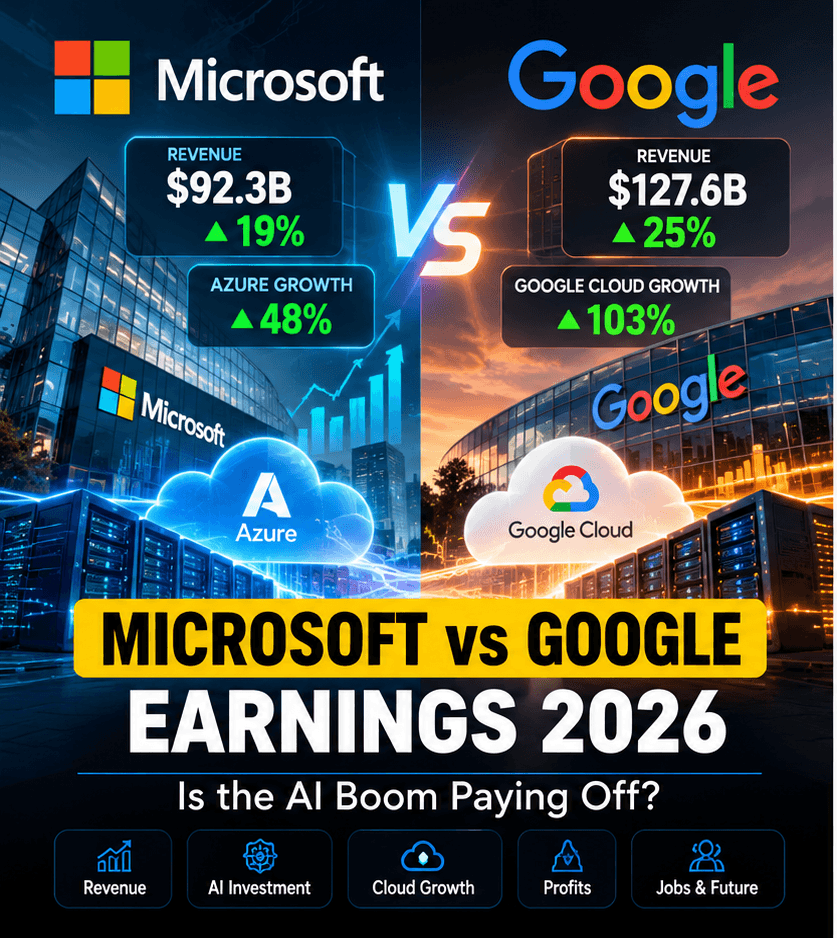
Microsoft just made $92 billion in three months. Google's parent company, Alphabet, made even more: $127.6 billion.
Big numbers. But here's the part most headlines skip. Together, the two companies spent nearly $97 billion on data centres and AI chips in that same quarter.
So the real question isn't "did they make money?" They did. The question is: is all that AI spending actually coming back?
Let's break down the Microsoft vs Google earnings 2026 results in simple words.
Key takeaways
Microsoft revenue: $92.3B (about ₹8.80 lakh crore), up 19%. Azure grew 48%.
Alphabet revenue: $127.6B (about ₹12.16 lakh crore), up 25%. Google Cloud revenue more than doubled (+103%).
AI spending (capex) this quarter: Microsoft $45.2B, Google $51.4B. Google's spending more than doubled in a year.
Google's free cash flow was negative $9.1B. It is spending more cash than its business brings in.
Investors' verdict: Microsoft stock rose about 4% after hours. Alphabet fell about 9%.
Microsoft vs Google earnings 2026 at a glance
Both companies reported results for July to September 2026 on 28 October 2026. (For Microsoft, this is Q1 of its financial year 2027.)
Google sells more, but Microsoft keeps more as profit. Data: official earnings releases, 28 Oct 2026.
Metric (Jul–Sep 2026)
Microsoft
Alphabet (Google)
Total revenue
$92.3B (+19%)
$127.6B (+25%)
Operating income
$45.9B (+21%)
$40.6B (+30%)
Net income
$36.6B
$26.2B (down 25%)
Cloud revenue
Microsoft Cloud $63.9B (+30%)
Google Cloud $30.7B (+103%)
Main AI cloud growth
Azure +48%
Google Cloud +103%
AI capex this quarter
$45.2B
$51.4B
Capex a year ago
$34.9B
$24.0B
Stock reaction (after hours)
Up ~4%
Down ~9%
INR figures in this article use $1 = ₹95.30 (29 October 2026). They are rough conversions to show scale, not company-reported numbers.
How much are Microsoft and Google spending on AI?
Ready to implement this?
Check out our premium e-books and digital guides for copy-paste templates and full frameworks.
A lot. More than almost any company has ever spent on infrastructure.
Google more than doubled its AI spending in a year.
"Capex" means capital expenditure. It's money spent on long-term stuff: data centres, servers, AI chips, power and cooling. This is where most AI money goes.
Microsoft spent $45.2 billion (about ₹4.31 lakh crore) this quarter, up roughly 30% from a year ago. It expects around $175 billion of capex for calendar 2026.
Google spent $51.4 billion (about ₹4.90 lakh crore), more than double the $24 billion it spent a year earlier. It has guided $195–205 billion for full-year 2026 and says 2027 will be "significantly" higher.
To put that in perspective, Google's spending in just these three months is bigger than the yearly revenue of most companies on the planet.
Is AI spending paying off? Our verdict
⚖️ Our honest answer: the revenue is real, but the payback isn't fully here yet.
Microsoft: closer to a clear payoff
Azure, Microsoft's cloud platform, grew 48%. That beat Microsoft's own forecast of 44–45%.
Even better, Microsoft has $677 billion in contracted future revenue (called commercial "RPO"), up 73% in a year. That's customers who've already signed up to pay later. It's the strongest sign that AI demand isn't just hype.
Microsoft's spending grew about 30%, while cloud revenue grew 30% too. Spending and earning are moving roughly together. That's why investors were happy.
Google: huge growth, but cash is tight
Google Cloud's numbers are stunning. Revenue doubled to $30.7 billion, and the cloud unit's profit margin jumped to 36.2% from 23.7% a year ago.
The Gemini app has also crossed 1 billion users, according to Alphabet.
So why did the stock drop? Three reasons:
Free cash flow turned negative: minus $9.1 billion. A year ago it was plus $24.5 billion.
Search growth slowed to 12%, down from 17% the previous quarter. Search is still Google's biggest money-maker.
Profit fell 25%, partly because of an $8.7 billion loss on investments it holds.
🎯 In short: Google is betting bigger and faster. The bet may pay off, but right now it's eating cash.
Which is growing faster, Azure or Google Cloud?
Azure is bigger, Google Cloud is growing faster.
On percentage growth, Google Cloud (+103%) beat Azure (+48%) this quarter. But Azure is still the bigger business at about $33.2 billion in quarterly revenue, compared with Google Cloud's $30.7 billion.
What does this mean for you?
You don't need to own shares to feel this.
AI tools may get better, and pricier
Companies spending $50 billion a quarter will want that money back. Expect more paid AI plans, like Copilot and Gemini subscriptions, and more AI features bundled into products you already pay for.
India is getting a share of the build-out
Both companies are building in India. Google announced a roughly $15 billion AI hub in Visakhapatnam in October 2025. Microsoft announced $17.5 billion in India cloud and AI investment in December 2025. That means more local data centres, faster AI services and some new jobs.
Your next laptop upgrade could cost more
AI data centres need huge amounts of memory and storage. That demand is pushing up RAM and SSD prices for regular buyers too, so upgrading your laptop or PC may cost more in the coming months.
Jobs and skills
AI is changing tasks more than wiping out whole jobs. Simple things like drafting emails, summarising and translating are getting faster. People who learn to use these tools well, and check their output, will have an edge.
What to watch next quarter
Capex vs cloud growth: If spending keeps rising faster than cloud revenue, worries will grow.
Google's cash flow: Does it stay negative, or turn around?
Search growth: Is AI helping Google Search or slowly eating into it?
Microsoft's RPO: Does the $677B backlog keep climbing?
Real AI revenue: Watch for actual numbers on Copilot and Gemini paid users.
FAQs
Who earned more in Q3 2026, Microsoft or Google?
Alphabet (Google) had higher revenue at $127.6 billion vs Microsoft's $92.3 billion. But Microsoft made more profit: about $36.6 billion in net income vs Alphabet's $26.2 billion.
Is AI spending paying off for Microsoft and Google?
Partly. Cloud revenue is growing fast for both, which shows real demand. Microsoft's spending and revenue are growing at a similar pace. Google's spending is growing much faster than its cash, so its free cash flow turned negative.
How much are Microsoft and Google spending on AI?
In July–September 2026, Microsoft spent $45.2 billion and Google spent $51.4 billion on capex, mostly AI data centres. For 2026, Microsoft expects about $175 billion and Google $195–205 billion.
Why did Google stock fall after earnings?
Alphabet shares fell about 9% after hours because free cash flow went negative (minus $9.1 billion), search growth slowed to 12% and profit dropped 25%, even though Google Cloud doubled.
Will AI make Copilot and Gemini more expensive?
Possibly. With this much money going into AI, both companies are pushing paid plans and premium features. Basic free versions will likely stay, but the best features are moving behind subscriptions.
Does Big Tech AI spending affect RAM and SSD prices?
Yes, it's one of the reasons. AI servers use huge amounts of memory and storage, which tightens supply for regular buyers and can push up prices for laptop and PC upgrades.
Bottom line
AI is already making serious money for Microsoft and Google. Cloud businesses are booming, and customers are signing long contracts.
But the spending race is getting extreme. Microsoft is keeping its costs and revenue roughly in step. Google is spending ahead of its cash.
Neither company has "won" the AI race yet. The next few quarters will show whether these giant bets turn into giant profits.