

Travel Power Bank Guide 2026: How to Choose + Flight Rules
Travel Power Bank Guide 2026: How to Choose the Right One (and Carry It on a Flight)
The best travel power bank for most people is a 10,000mAh to 20,000mAh model with USB-C Power Delivery (at least 20W), a weight under 450g (around 200g for a pocket-size 10,000mAh), and a rating below 100Wh so it is allowed in cabin baggage on every major airline. If you carry a laptop, look for 65W or more. And remember, on flights in India you can carry a power bank in your hand bag, but you cannot use it or charge it during the flight.
That's the quick answer. But if you've ever stood in a shop staring at boxes that all say "20,000mAh, Fast Charging", you know it isn't that simple.
Most buying guides stop at "pick 10,000mAh or 20,000mAh". This one goes further. You'll learn how many charges you actually get (it's less than the box says), how to read the Wh rating that airport security checks, what changed in India's flight rules, and what you should pay.
What Is a Travel Power Bank?
A travel power bank is a portable battery pack that stores electricity so you can charge your phone, earbuds, smartwatch, tablet or laptop without a wall socket.
Any power bank can travel with you. But a good travel power bank is built for life on the move. It is:
Light enough to carry all day in a bag or pocket.
Fast, so 30 minutes at a café gives you real battery.
Flight-safe, meaning its Wh rating is within airline limits.
Versatile, with ports for all your devices, usually USB-C plus one USB-A.
Why You Should Carry a Power Bank When You Travel
Your phone is now your ticket, map, wallet and camera. When it dies on a trip, a lot stops working at once.
Tickets and boarding passes: Train e-tickets, DigiYatra at airports and mobile boarding passes all live on your phone.
Payments: UPI handles most small payments in India now. No battery, no PhonePe or GPay.
Navigation: Google Maps with GPS and mobile data on drains your battery fast, especially on long drives.
Cabs and hotels: Booking an Uber, Ola or Rapido, or showing your hotel booking, needs a working phone.
Safety: In an emergency, a charged phone is the most important thing you have.
Charging points are unreliable: Airport sockets are crowded. On trains, the charging point is often shared or broken, and since March 2021 Indian Railways has directed that coach charging points be switched off from 11 PM to 5 AM as a fire precaution.
How Many Charges Will You Actually Get? (The mAh Truth)
This is the part most guides skip, and it's where most buyers feel cheated.
A power bank never delivers its full rated energy to your phone. In real use, about 60 to 70 percent of the rated energy actually ends up in your phone's battery.
Where does the rest go? Mostly heat, lost in two places:
Inside the power bank: Its cells store energy at about 3.7 volts. A converter circuit steps this up to 5V, 9V or more for the USB port, and some energy is lost as heat along the way.
Inside your phone: Your phone's own charging circuit steps the voltage back down to charge its battery, and loses some more energy as heat. If you use the phone while it charges, that eats into the charge too.
There's one more small factor. Most modern phone batteries run at a slightly higher voltage (about 3.85 to 3.9V) than standard power bank cells (3.7V). So a 5,000mAh phone battery holds about 19.3Wh of energy, a little more than 5,000mAh of 3.7V power bank cells (18.5Wh).
Here's a realistic estimate for a phone with a 5,000mAh battery (most Android phones in India today have 5,000mAh or more). The middle column is the energy that actually reaches your phone, not the rating on the label:
Power bank capacity | Rated energy (on the label) | Energy delivered to phone (60 to 70%) | Full charges for a 5,000mAh phone |
|---|---|---|---|
5,000mAh | 18.5Wh | About 11 to 13Wh | About 0.6 to 0.7 |
10,000mAh | 37Wh | About 22 to 26Wh | About 1.1 to 1.3 |
20,000mAh | 74Wh | About 44 to 52Wh | About 2.3 to 2.7 |
25,000 to 27,000mAh | 92.5 to 99.9Wh | About 56 to 70Wh | About 2.9 to 3.6 |
If you use an iPhone, the numbers look better because iPhone batteries are smaller (roughly 3,300 to 4,700mAh depending on the model). A 10,000mAh power bank gives most iPhones one and a half to two full charges.
Simple rule: Multiply the power bank's mAh by 0.65, then divide by your phone's battery mAh. That's roughly how many full charges you'll get. (Because phone batteries run at a slightly higher voltage, the real number may be a little lower.)
How to Read the Wh Rating (and Why Airports Care)
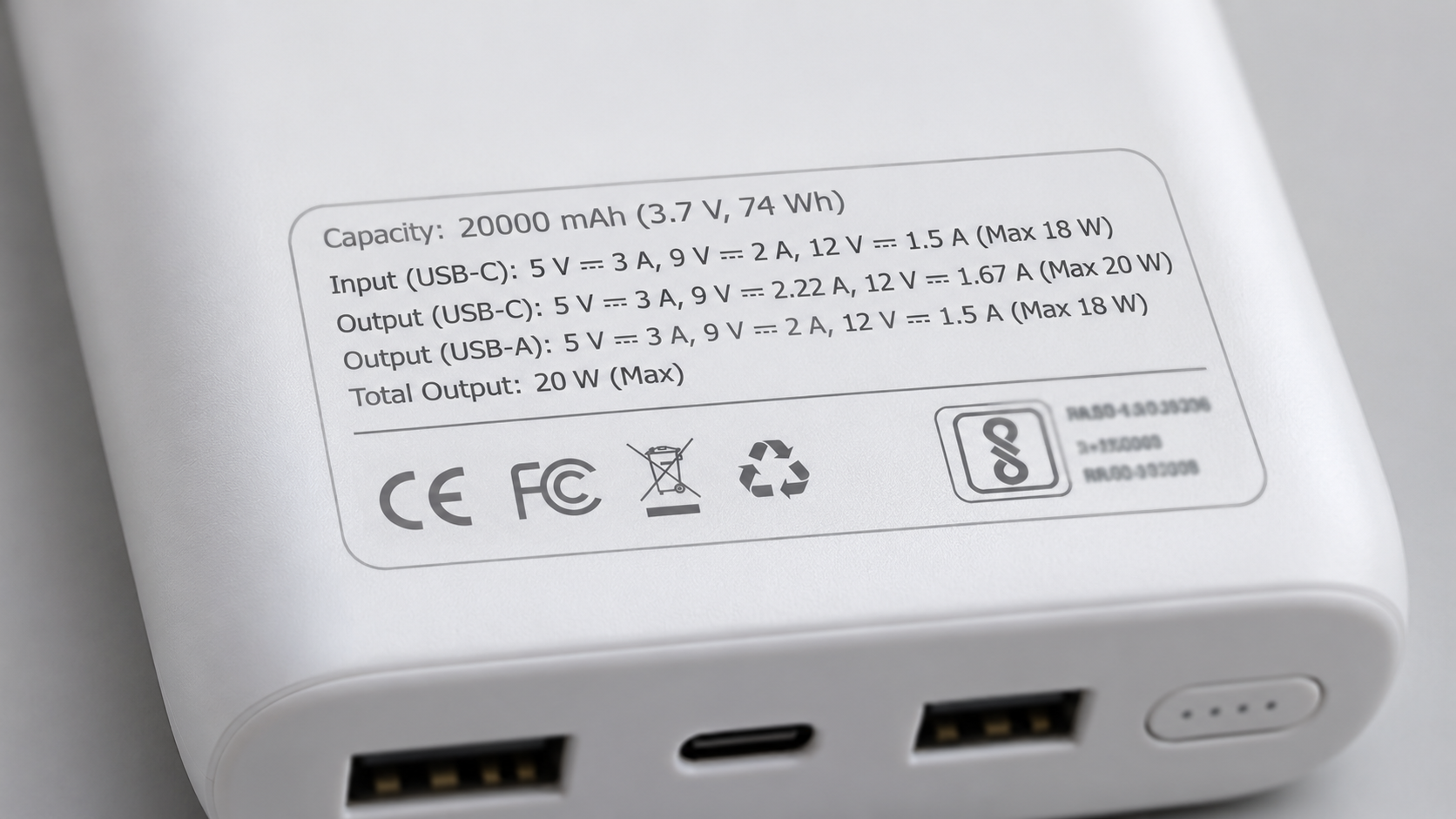
Shops sell power banks by mAh. Airlines check them by Wh (watt-hours), the rated energy printed on the label.
Important: Airlines look at this rated energy, not the smaller "delivered" energy from the table above. So a 20,000mAh power bank counts as 74Wh at the airport, even though only about 44 to 52Wh of it reaches your phone.
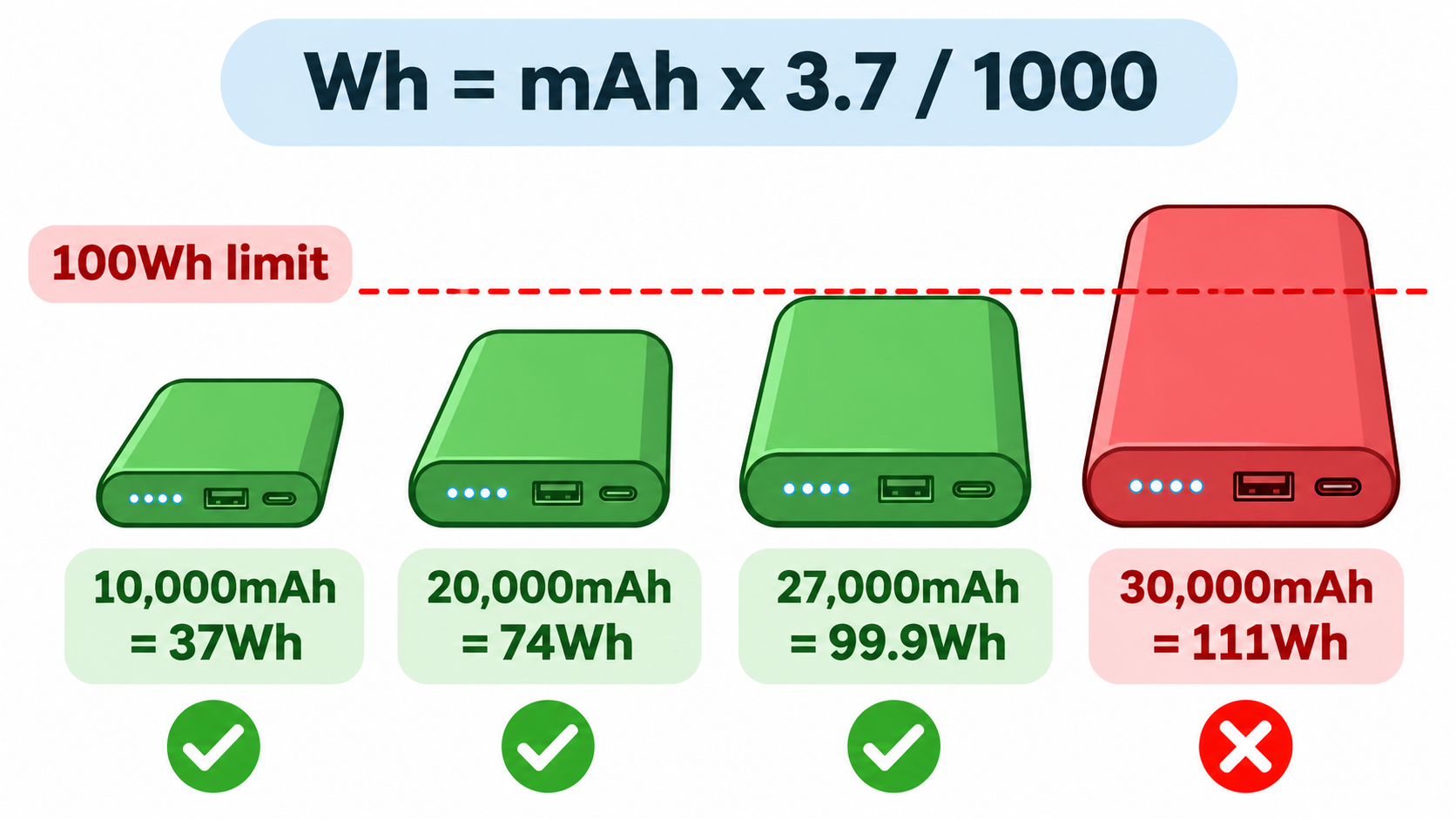
The formula: Wh = (mAh × cell voltage) ÷ 1,000
Most power banks use 3.7V cells. Some newer, high-density models use 3.85V or 3.91V cells, which gives a higher Wh rating for the same mAh. For example, the Stuffcool Giga Max is 25,000mAh but 96.25Wh (3.85V), and the Stuffcool Nido is 10,000mAh but 39.1Wh (3.91V). So always go by the Wh printed on the label, not your own maths.
For standard 3.7V power banks, use this table:
mAh | Wh (at 3.7V) | Allowed in cabin? |
|---|---|---|
10,000mAh | 37Wh | Yes |
20,000mAh | 74Wh | Yes |
25,000mAh | 92.5Wh | Yes |
27,000mAh | 99.9Wh | Yes, just under the limit |
30,000mAh | 111Wh | Only with airline approval (where allowed) |
50,000mAh | 185Wh | No |
So for a 3.7V power bank, the limit is about 27,000mAh. For a 3.85V power bank, it drops to about 25,900mAh. A "27,000mAh" pack with 3.85V cells is about 104Wh, which is over the 100Wh line.
Power Bank Rules on Flights in India (2026 Update)
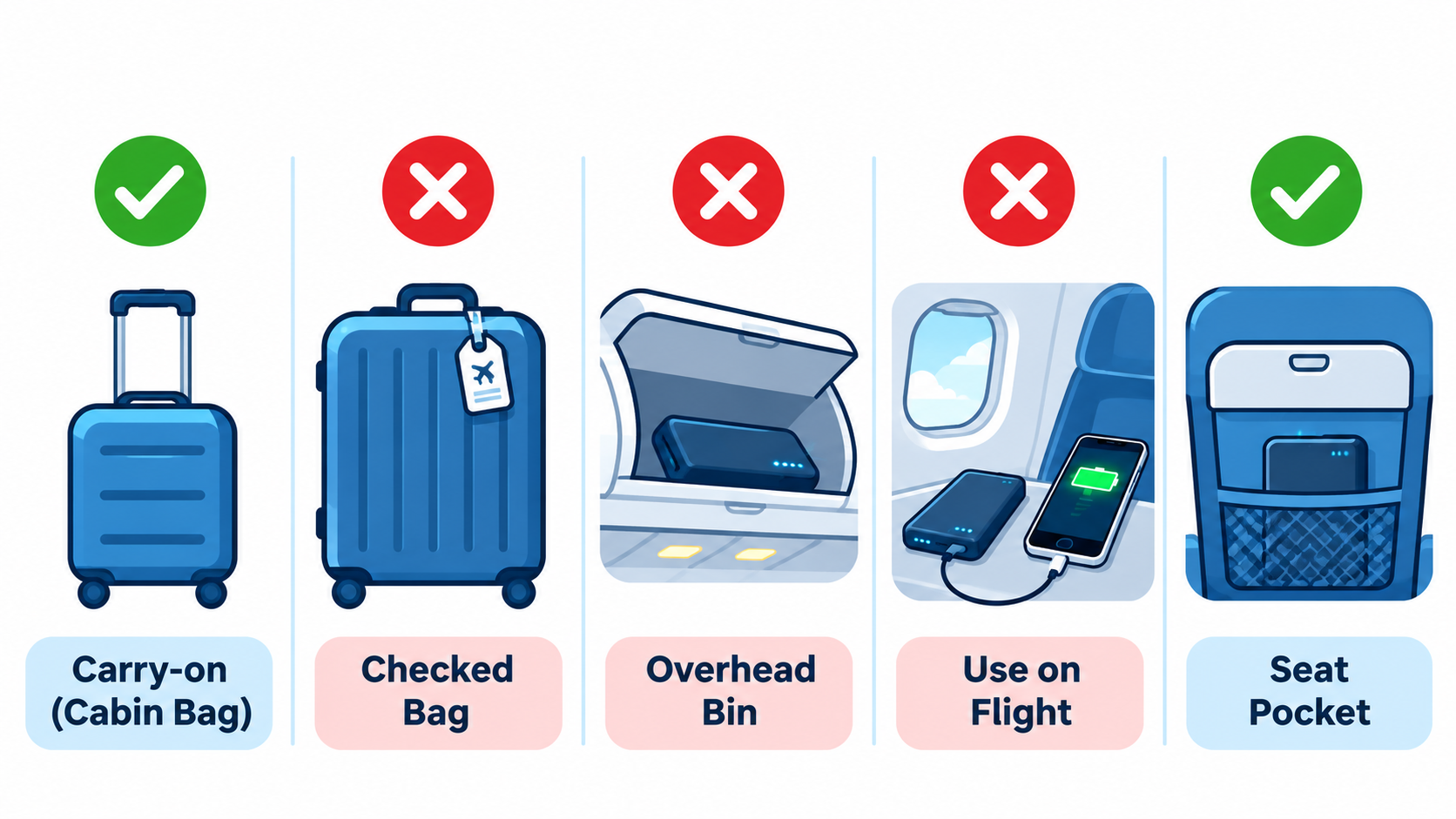
Yes, you can carry a power bank on a flight in India, but only in your cabin (hand) baggage, and you cannot use it or charge it during the flight.
What the DGCA rule says
India's aviation regulator, the DGCA, issued a Dangerous Goods Advisory dated 11 November 2025. Airlines began strictly enforcing it, with onboard announcements, in early January 2026. The advisory says:
Hand baggage only. Power banks and spare lithium batteries must never go in checked baggage.
No using or charging power banks during the flight. You can't charge your phone from a power bank, and you can't charge the power bank from the seat power or USB outlet.
No overhead bins. Keep the power bank in the seat pocket, under the seat in front, or on you, where you can see it.
Tell the crew at once if any device gets hot, smokes or smells odd.
Why the rules got stricter
Lithium batteries can overheat and catch fire if damaged or poorly made, a problem called "thermal runaway". Two incidents led directly to the tighter rules:
January 2025: A power bank fire destroyed an Air Busan plane in South Korea. Airlines across Asia began tightening rules after this.
19 October 2025: A device in a seat-back pocket caught fire on IndiGo flight 6E 2107 (Delhi to Dimapur) at Delhi airport, and the plane returned to the bay. The DGCA advisory followed within a month.
Incidents since the rules came in
Fires have continued, which is why following the rules matters:
5 May 2026: A passenger's power bank caught fire on IndiGo flight 6E 108 (Hyderabad to Chandigarh) after landing. Passengers were evacuated by slides.
11 October 2026: A power bank in an overhead bin caught fire on IndiGo flight 6E 6115 (Delhi to Chennai), and the plane was diverted to Hyderabad. This is exactly why power banks must stay where you can see them.
Capacity limits for flights
Power bank rating | Cabin baggage | Checked baggage |
|---|---|---|
Up to 100Wh | Allowed | Not allowed |
100Wh to 160Wh | Only with prior airline approval, and some airlines don't allow it at all | Not allowed |
Above 160Wh | Not allowed | Not allowed |
No rating printed / damaged label | May be refused at security | Not allowed |
Airline-wise rules in India
All Indian airlines follow the same DGCA baseline: hand baggage only, no in-flight use or charging, no overhead bins, and up to 100Wh without approval. On top of that:
Air India: Maximum two power banks per passenger, each up to 100Wh.
IndiGo: The Wh rating must be visible on the power bank. 100Wh to 160Wh needs prior approval from the airline. Above 160Wh is not allowed.
Akasa Air and SpiceJet: 100Wh to 160Wh needs prior airline approval.
Flying abroad? Check these too
Since 27 March 2026, ICAO (the UN's aviation body) limits passengers to two power banks each and bans recharging a power bank during the flight. These are part of ICAO's dangerous goods rules.
ICAO's rule doesn't itself ban using a power bank to charge your phone in flight. That ban comes from national regulators like India's DGCA and from individual airlines, which is why in-flight use rules still differ from airline to airline.
Emirates: Only one power bank under 100Wh, and you can't use it on board.
Southwest Airlines (US): Only one power bank (up to 100Wh) per passenger since 20 April 2026. It can't go in the overhead bin or be charged from seat power, and if you use it, it must be visible, not inside a bag.
Singapore Airlines, Cathay Pacific, Lufthansa Group and Qantas have also restricted in-flight use.
Rules change often, so check your airline's website a day before you fly.
How to Choose the Best Power Bank for Travel: 9 Things to Check
1. Capacity (mAh) based on your trip
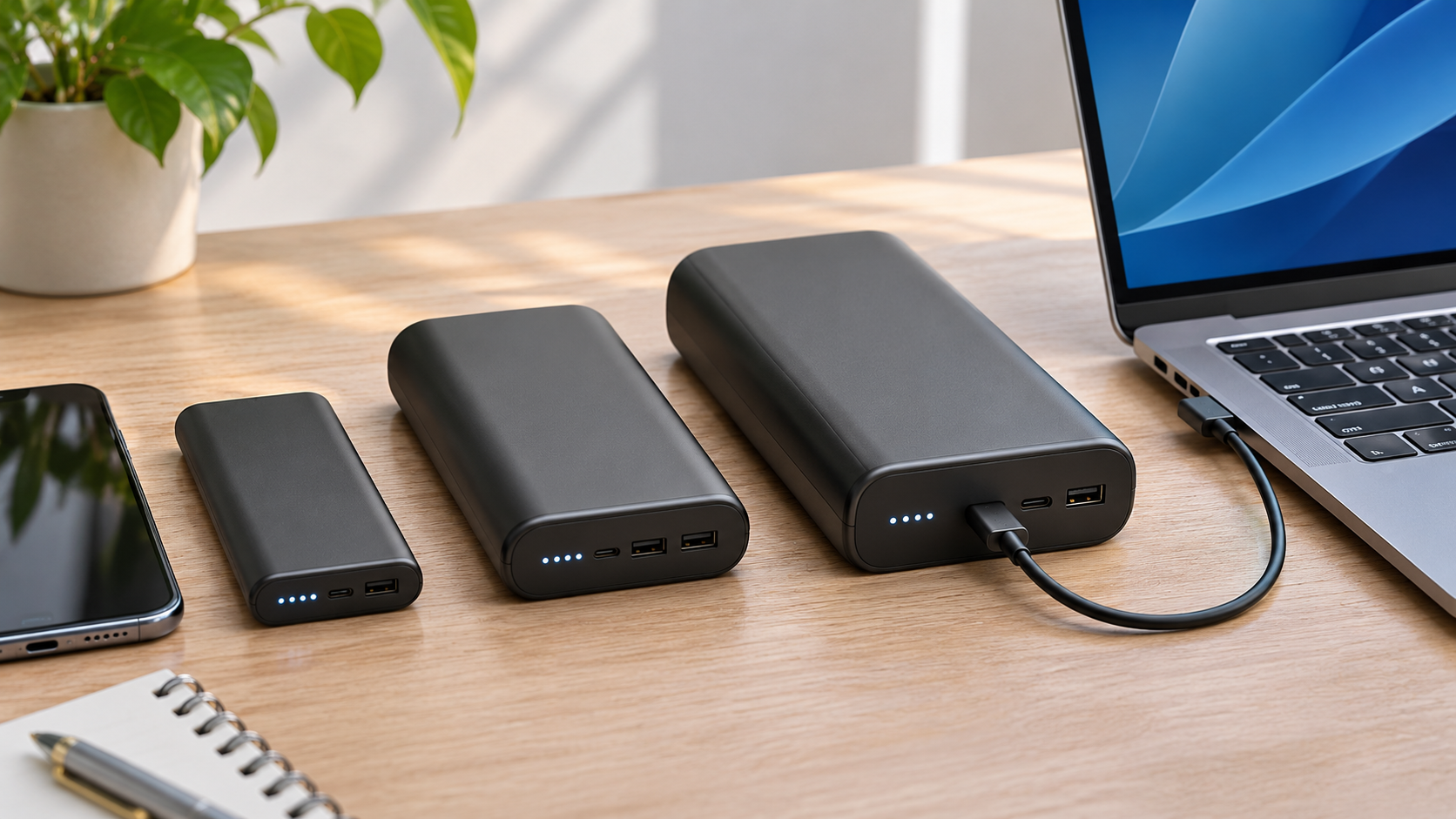
Use the "real charges" table above. For most travellers in India, 10,000mAh is right for day trips and flights, and 20,000mAh is right for weekends and train journeys. Bigger isn't always better, because more mAh means more weight.
2. Output power in watts (W)
mAh tells you how much. Watts tell you how fast.
10 to 12W: Slow. Avoid for travel.
18 to 22.5W: Good for most phones.
30 to 45W: Great for fast-charging phones and iPads. Can slowly charge thin, low-power laptops like a MacBook Air or a Chromebook.
65 to 100W: Needed to properly charge most laptops while you use them.
140W and above: Only for high-power laptops that support USB PD 3.1 (Extended Power Range).
3. Fast charging standard (PD, PPS and QC)
USB Power Delivery (PD) on a USB-C port is the universal standard. iPhones (iPhone 8 and later) charge at full speed with normal USB-C PD.
Samsung and Google Pixel users need one more thing: PPS (Programmable Power Supply). Samsung's 25W and 45W Super Fast Charging only works with PD chargers that support PPS. Without PPS, a Samsung phone is capped at about 18W, even on a 45W power bank. So check for "USB-C PD with PPS" on the box. For 45W charging, you also need a 5A cable.
Quick Charge (QC) is an older standard, mostly used on USB-A ports for older Android phones.
Some brands have their own fast charging (like OnePlus, Oppo or Xiaomi's high-speed charging). A normal power bank won't charge these phones at their top speed, but it will still charge them at a normal fast rate.
4. Ports: how many and which type
A good travel power bank has at least one USB-C port (input and output) and one USB-A port for older cables and earbuds. Two USB-C ports are better if you carry a phone and a tablet.
Two catches:
"22.5W" doesn't always mean 22.5W on USB-C. On many budget power banks, the full 22.5W comes only from the USB-A port, while the USB-C PD port tops out at 20W. Check the per-port output on the label.
Speed is shared. When you charge two devices together, the total output is usually split. A "22.5W" power bank may drop to 15W total with two devices connected.
5. Weight and size
Here's a rough guide:
10,000mAh: about 180 to 230g. Fits in a jeans pocket.
20,000mAh: about 350 to 450g. Belongs in a backpack.
Laptop power banks (65W+, 20,000 to 27,000mAh): about 450 to 600g.
If you'll carry it in your hand or pocket all day, anything over 350g starts to feel heavy.
6. Recharge speed of the power bank itself
This one is often ignored. A 20,000mAh power bank stores 74Wh, so it takes time to refill:
With a basic 10W charger: about 10 hours or more.
With an 18 to 20W charger: about 6 to 7 hours. (Xiaomi rates its 20,000mAh Power Bank 4i at about 6.9 hours with an 18W charger.)
With 30W or more PD input: about 3.5 to 4.5 hours, if the power bank supports that input.
If you only get one night in a hotel, check the "input" spec, not just "output".
7. Built-in cable, wireless or MagSafe
Built-in USB-C cable: One less thing to forget. Very handy for travel.
Wireless and MagSafe: Snaps onto the back of an iPhone or a compatible Android phone. Standard Qi2 charges at up to 15W, while newer Qi2.2 power banks reach 25W. Wireless charging wastes more energy than a cable, so you get fewer charges.
8. Battery type and safety protection
Most power banks use lithium-ion or lithium-polymer cells. Lithium-polymer models are usually slimmer and lighter.
A few newer power banks use LiFePO4 (lithium iron phosphate) cells. These are more resistant to overheating and last many more charge cycles, but they're heavier for the same capacity, and still rare in pocket-size power banks.
Whatever the type, look for protection against overcharging, overheating, short circuits and over-current.
9. BIS certification (very important in India)
Power banks sold in India must be registered with the Bureau of Indian Standards (BIS) under its Compulsory Registration Scheme (CRS). Here's how to check one in the shop:
Find the BIS mark with a registration number that starts with "R-" on the box or body. You'll usually see the Indian Standard printed near it, such as IS 16046 (Part 2) for lithium battery packs or IS 13252 (Part 1) for IT equipment safety.
Open the free BIS Care app (Android and iOS) and choose "Verify R-No under CRS".
Enter the R-number. The app shows the registered manufacturer. If the brand doesn't match, or the number isn't found, don't buy it.
Fake sellers often print a BIS logo or copy a real R-number from another product, so the app check matters.
Which Capacity Is Best for Your Type of Trip?
Type of trip | Recommended capacity | Recommended output |
|---|---|---|
City day out, office commute | 5,000 to 10,000mAh | 18 to 20W |
Domestic flight (2 to 3 hours) | 10,000mAh | 20W PD |
Overnight train journey | 20,000mAh | 20W PD or more |
Weekend road trip with family | 20,000mAh with 3 ports | 22.5W or more |
Hill station or trek (Himachal, Uttarakhand, Ladakh) | 20,000mAh, rugged body | 20W PD or more |
Work trip with laptop | 20,000 to 25,000mAh, under 100Wh on the label | 65 to 100W PD |
International trip | 10,000 to 20,000mAh (under 100Wh) | 20 to 45W PD |
A trekking tip: lithium batteries lose capacity in cold weather. In places like Ladakh or Spiti, keep the power bank inside your jacket or sleeping bag at night, not in an outer bag pocket.
Travel Power Bank Price in India (2026)
Prices change with sales, but here's what you can expect to pay for a good, branded power bank:
Type | Typical price range |
|---|---|
10,000mAh, 20 to 22.5W | ₹900 to ₹1,700 |
20,000mAh, 22.5 to 33W | ₹1,100 to ₹2,500 |
MagSafe / Qi2 wireless, 5,000 to 10,000mAh | ₹2,500 to ₹6,000 |
Laptop power bank, 65 to 100W | ₹4,500 to ₹8,000 |
Popular travel power banks in India
Here are some well-reviewed options, with prices as listed by Digit in June 2026. Check the current price before you buy.
Model | Capacity | Output | Good for | Price (approx.) |
|---|---|---|---|---|
10,000mAh | Up to 22.5W, 2x USB-C + USB-A | Budget daily carry | ₹999 | |
20,000mAh | Up to 22.5W, USB-C PD + USB-A | Budget long trips | ₹1,099 | |
10,000mAh | 33W, 199g | Light and fast | ₹1,699 | |
20,000mAh (74Wh) | 33W PD, 3 ports, 440g | Family trips | ₹2,099 | |
10,000mAh (39.1Wh) | 25W wireless, 45W wired | iPhone / MagSafe users | ₹4,999 | |
25,000mAh (96.25Wh) | 100W, built-in cable | Full laptop charge, flight-safe | ₹5,299 | |
12,000mAh | 100W | Emergency laptop top-up (about half a charge) | ₹6,399 |
A note on the UGREEN: it's compact and very fast, but at 12,000mAh it only gives roughly half a charge to a typical thin laptop. For a full laptop charge on a work trip, choose a 20,000 to 25,000mAh laptop power bank.
Other trusted brands in India include Anker, Ambrane, boAt, Urbn, Portronics and pTron. Most offer 20,000mAh, 22.5W models between ₹1,200 and ₹2,000.
How to spot a fake or low-quality power bank
Too light for its capacity: A "20,000mAh" power bank that weighs 200g is almost certainly lying.
Too cheap: A 30,000mAh power bank for ₹600 is a red flag.
No BIS R-number, or one that fails in the BIS Care app: This is the biggest safety red flag. Don't buy it.
No Wh rating printed: Some genuine budget models skip it, so this isn't proof of a fake. But airport security may refuse a power bank without a visible Wh rating, so avoid it if you fly.
Unknown seller with no warranty or service centre.
10 Tips for Using a Power Bank While Travelling
Charge it to 100 percent the night before you leave. Power banks slowly lose charge when not in use, so top up right before a trip.
Carry a good cable. A cheap cable can cut your 20W charging down to 5W. For laptops, use a cable rated for 60W or 100W.
Keep it in your hand bag, always. Never pack it in checked luggage.
Take it out if your cabin bag gets gate-checked. On full flights, staff sometimes send cabin bags to the hold at the boarding gate. Remove your power bank and spare batteries before you hand the bag over.
Protect the ports. Keep the power bank in a pouch or its sleeve so keys or coins can't touch the ports and cause a short circuit.
Keep it where you can see it on the plane. Seat pocket or under the seat, never the overhead bin.
Charge your phone to 100 percent at the gate. Since you can't use the power bank on Indian flights, top up before you board.
Avoid heat. Don't leave it on a car dashboard, in direct sun, or under a pillow while charging. Stop using it if it swells, gets very hot or smells odd, and dispose of it at an e-waste collection point.
Use a strong enough charger at the hotel. If you charge your phone and power bank together overnight, use a dual-port USB-C PD charger with at least 35W total output (45 to 65W is better), so the power bank still gets 20W or more.
Between trips, store it at 20 to 80 percent. Lithium batteries last longer when they aren't kept full or fully empty for weeks. This is for storage at home. Before a trip, charge it fully (tip 1), and try not to run it down to 0 percent often.
Quick Reference: Key Facts and Common Mistakes
Wh formula: Wh = (mAh × cell voltage) ÷ 1,000. At 3.7V, a 20,000mAh power bank is 74Wh. Always trust the Wh printed on the label.
Flight limit: Up to 100Wh is allowed in cabin baggage on all major airlines. Never in checked baggage.
India rule: Since the DGCA advisory of 11 November 2025 (enforced from January 2026), you can't use or charge a power bank on Indian flights, or keep it in the overhead bin.
Real capacity: Only about 60 to 70 percent of the rated energy reaches your phone. A 10,000mAh power bank gives about 1.1 to 1.3 charges to a 5,000mAh phone.
Mistake to avoid: Buying the biggest mAh. A 30,000mAh power bank is heavy and may not be allowed on your flight.
Mistake to avoid: Ignoring watts and PPS. High mAh with 10W output charges slowly, and Samsung phones need PPS for fast charging.
Laptops: 30 to 45W can slowly charge thin laptops; 65 to 100W is needed for most laptops in use.
Mistake to avoid: Skipping the BIS check to save ₹300. Verify the R-number in the BIS Care app.
Price: A good 20,000mAh, 22.5W power bank costs about ₹1,100 to ₹2,500 in India.
Frequently Asked Questions
Which power bank is best for travel?
For most people, a branded, BIS-certified 10,000mAh or 20,000mAh power bank with USB-C PD (20W or more) is best. Choose 10,000mAh for flights and day trips, 20,000mAh for long trips, and a 65W or higher model if you need to charge a laptop.
Is a power bank allowed on flights in India?
Yes, but only in cabin baggage. Under the DGCA advisory, you can't use it or charge it during the flight, and it must not go in the overhead bin.
How much mAh power bank is allowed on a flight?
Airlines go by Wh, not mAh. Up to 100Wh is allowed on all major airlines. For a standard 3.7V power bank, that's about 27,000mAh; for 3.85V cells, about 25,900mAh. Between 100Wh and 160Wh needs airline approval, and above 160Wh is not allowed.
Is a 20,000mAh power bank allowed on a flight?
Yes. A 20,000mAh power bank is usually about 74Wh, well under the 100Wh limit. Carry it in your hand baggage.
Can I keep a power bank in checked baggage?
No. Power banks are not allowed in checked baggage on any airline. If your cabin bag is checked in at the gate, take the power bank out first.
How many power banks can I carry on a flight?
Under ICAO rules, a maximum of two per passenger. Air India also allows two (up to 100Wh each). Emirates and Southwest Airlines allow only one. Check your airline before you fly.
Can I use a power bank on a train in India?
Yes. There's no rule against using a power bank on Indian trains, and it's very useful because coach charging points are often shared, broken, or switched off from 11 PM to 5 AM.
Is 10,000mAh enough for travel?
For a one-day trip or a flight, yes. It gives about 1.1 to 1.3 full charges to a typical 5,000mAh Android phone, or one and a half to two charges for most iPhones.
How long does a power bank last?
A good lithium-ion power bank usually lasts about 300 to 500 full charge cycles, which is 2 to 3 years of regular use. LiFePO4 power banks last many more cycles, but they're heavier and less common.
Can a power bank charge a laptop?
Only if it supports USB-C PD with enough power. A 30 to 45W power bank can slowly charge thin, low-power laptops like a MacBook Air or a Chromebook. For most laptops in use, you need 65 to 100W.
Why does my power bank give fewer charges than expected?
Because about 30 to 40 percent of the energy is lost as heat in the power bank's converter circuit and your phone's charging circuit. Phone batteries also run at a slightly higher voltage than power bank cells. This is normal.
Final Thoughts
The right travel power bank isn't the biggest one. It's the one that fits your trip, charges fast, and gets through airport security without trouble.
For most Indian travellers, that's a BIS-certified 10,000mAh or 20,000mAh power bank with USB-C PD (and PPS if you use a Samsung or Pixel). Check the Wh on the label, keep it in your hand bag, charge your phone at the gate, and you're set.
Sources (accessed November 2026): DGCA Dangerous Goods Advisory on power banks, 11 November 2025, as reported by Goodreturns (4 January 2026); ICAO, "New power bank restrictions will safeguard international aviation" (27 March 2026); Southwest Airlines, "Power banks/portable chargers" help page; Air India, IndiGo (Dangerous Goods Policy), Akasa Air and SpiceJet baggage rules as summarised by Esquire India (12 October 2026); Emirates and other carrier rules as summarised by Wego (updated May 2026); Deccan Herald, IndiGo 6E 2107 fire report (19 October 2025); PTC News, IndiGo 6E 108 fire report (5 May 2026); Business Today, Indian Railways night charging restriction (30 March 2021); Bureau of Indian Standards, BIS Care app; Xiaomi India, Power Bank 4i specifications; Stuffcool, Nido product page; Android Authority, Samsung Super Fast Charging explainer (31 March 2025); Digit, "Best power banks for phones in India in 2026" (June 2026).